• Skip to main content
  • Skip to primary sidebar
  • Skip to footer

Carolyne J Montgomery - Reader & Writer

Carolyne Reads and Writes

  • Home
  • About
    • Socials
      • Facebook
      • Instagram
  • Watermarked Series
  • Publications & More
    • Indie Bookstores

Interlinked Short Story Collection

Chapter 8: The Road Trip

August 15, 2026 by Carolyne Montgomery Leave a Comment

On Nan’s last wish road trip to Myrtle Beach, Brianna and Stéphanie learn of the illegitimate baby Nan gave up at birth, a loss which diminished her ability to love Claire adequately. Stéphanie challenges Brianna’s dominant role.

The Road Trip

Nan shuffled around inside the RV, staying upright by grasping the counters. She was eighty-three with newly diagnosed, incurable pancreatic cancer. Two days ago, she declared her wish to go to Orlando. She’d refused to fly, so Brianna, her granddaughter, had rented the RV to drive the two thousand kilometres from Montreal to Florida. 

Nan’s flowery toiletries bag was plump with vials of her painkillers and sleeping pills. “I’ve hidden the best meds under the cushions. You never know what will happen at the border,” she said to her two granddaughters.

Two days before, Stéphanie, Brianna’s younger sister, completed the online Blue Cross forms on the computer in her mom’s office. “What about health insurance, for you, Nan?”

“Cancer. They won’t approve me. I’ll do without. But don’t tell your mom. If I get sicker, we come home.”

“I’m not on board for that, Nan,” said Stéphanie.

“Chill!” Brianna said pushing Stéphanie back into her chair. “Finish our forms. Don’t worry about Nan’s.”

“Mom will kill us if she finds out we didn’t get insurance for Nan.”

But Mom wasn’t coming with them. She’d be at her migratory bird meeting in Ottawa. That was why Brianna knew about the Hudsonian Godwit, a shorebird that migrates from the Mackenzie Delta to Tierra del Fuego, much further than an RV trip to Florida. 

Dad would have been up for the whole adventure. The thought of him caught Brianna off guard. He’d died suddenly nearly a year ago. He’d been her ally. He’d taught her how to split wood as soon as she could manage the half-axe and to drive his jeep when she turned sixteen. He would have been proud of her for taking on this adventure with Nan.

Nan pressed her face up against the office window. Outside, the purple asters at the edge of the brown lawn bloomed. Her voice was quiet and frail. “When your mom, Claire was little, we were so poor I told her that Disneyland was only for sick kids, kids with cancer.” Her thick, pewter braid swung over her rounded back. “Well, I’m not a kid but I’ve sure got cancer. Let’s go before it’s too late.”

By the time they’d driven through Brossard, Nan, nestled under the lilac waffle blanket on the pull-out bed, was snoring lightly like a snoozing cat. Her sallow skin sagged from her jaw. 

Brianna drove, glued in the right-hand lane of the freeway. She couldn’t depend on Stéphanie to check the left-hand mirror for traffic. Transport trucks whizzed by them. Changing into the righthand lane scared her. When she dared take her hand off the wheel, she tugged at her cut-off shorts that were creeping up into her crotch. Her body was grimy and sticky. She should have paid more attention when the guy at the rental place showed her how to work the A/C. 

Stéphanie sat with her long legs folded underneath her nodding to the music from her earbuds. Her tanned chest was wrapped in a violet tube top. “Would Nan notice if we drove around the townships for a while and camped near Sherbrooke?”

Brianna flashed a dark look at her. “We said we are going to Orlando and that’s what we’re doing.”

“Sorry. I’m in. We’re in this together.”

Even before Stéphanie was hospitalized with anorexia when she was fourteen, Mom and Nan had always given Stéphanie more attention. She was the sunny, more beautiful one. Brianna’s A’s, swimming ribbons and mom-yessing only added up to her having more responsibilities. She’d been the one who walked Stéphanie to school, made sure she had her lunch and, in winter, didn’t lose her hat or mittens.

Yesterday at dinner, Brianna made the macaroni and cheese, filled the dishwasher, and scraped the sticky pan, while Claire, seated at the kitchen table, carried on about her work stuff—The Conservation Trust meeting that night and her keynote speaker engagement in Ottawa on the weekend. Stéphanie nodded like she was listening but was texting her friends.

Two hours later, they pulled up to the American border. They inched past the flashing sign indicating a ten-minute wait and towards the booth. The officer was a young woman, intimidating in her uniform and likely armed. “Purpose of your trip,” she asked, scanning their three faces and the interior of the RV.

“We’re taking our grandmother to Disney World for a week. It’s a last-wish trip.” Brianna forced a smile. She was pretty sure Nan had brought along her THC gummies and it would be a drag if they got searched.

“Rental Vehicle? I’ll need the papers and your passports.” The officer’s expression remained stony as she examined the passports, the RV rental contract and whatever was on the computer screen in her booth. They waited in silence. Finally, she said, “Have a safe trip, ladies.”

“Hello U.S.A.,” Stéphanie exclaimed as the RV lurched away from the crossing into New York State.

After a long day of interstate freeway driving, they arrived at the Walmart Super Centre in Emporia, Virginia, where the camping and Wi-Fi were free. RVs and long-haul rigs clustered about the parking lot like prairie wagons.

Brianna squinted into the evening sun as she carried twelve Corona in an insulated bag and the two salad kits across the tarmac. She’d left Stéphanie in the RV in charge of their snoring grandmother.

Brianna yanked open the flimsy door of the RV. The smell of stale Dominos, Subway and of Nan’s Depends wafted out. She knelt on the worn linoleum floor and opened the mini-fridge door. It stank like a bar at closing time. Brianna understood the spilt beer but who kept cigarettes in the fridge? She stuffed the salad kits inside. Mom would have been disgusted by all the plastic. She’d have figured out a way to make a salad from scratch.

“More fun than dating, eh, Stéph?” Briana asked, showing the Corona cooler to her. They were both between boyfriends, so the idea of a road trip seemed even more like fun.

“No kidding. Beer please.”

“First let’s get Nan to the Walmart washroom.”

Nan was curled up asleep on the bed contraption. Brianna woke her up.

“Come on Nan, put your arms around our shoulders. Let’s get you to the restroom before it closes.” Brianna braced her left hand on her right forearm and gripped Stéphanie’s left forearm with her right hand. Stéph’s hands were moist. She crossed her arms in the same under-and-over pattern and grasped Brianna’s arms. “Check?” said Brianna.

“Check,” replied Stéphanie.

They scooped Nan onto the solid square of their arms. Her near weightlessness startled Brianna. Were they holding Nan up or stopping her from floating away?

Brianna’s nose wrinkled at the dense ammonia odour that cancelled out Nan’s familiar Noxzema scent. They see-sawed through the doorway and inched her down the steps of the RV.

Nan blinked into the glaring light. “Careful girls!” She giggled and kicked her legs in the air as they floated her across the shimmering asphalt. Their flip-flops slapped beneath them.

“Everybody OK?” Brianna asked.

“I need to pee too.” Stéphanie laughed. 

Brianna wondered if she understood how sick Nan was.

The September sun was setting over the Walmart sign when Brianna had finished setting up the three camp chairs in the shade of the pull-out canopy. The girls lowered Nan into her chair.

“Mom’s gonna take this Corona bag and label it with her fat Sharpie the second we get home, so re-usable, so collapsible,” Stéphanie said. She lowered herself into the chair beside Nan and pulled out three beer.

They sat bathed in the white hiss of the traffic on the I-95. The scent of honeysuckle from the garden centre of the Walmart wafted over them. If Claire were here, she’d be identifying the chirping birds roosting in the potted shrubs.

“You know girls, your mom and I weren’t very close,” Nan said, the beer fizzing over her fingers and onto the tarmac.

Brianna leaned towards her to hear her better.

“Your mother never knew her dad.” Nan picked at the seam on her new stretch pants. She’d given up sewing her clothes because of her back pain. “I know your mom is having a tough time since your dad died. But I raised Claire alone for years. She wasn’t even two when Alain got killed in Cypress. I never understood why he volunteered for the Peace Corps.”

The girls nodded indulgently at the well-worn tale. Nan fiddled with the folds in the streaky orange chiffon scarf tied about her head. Brianna cracked open a second beer.

“But look at how happy she is now, with two beautiful daughters. Saving owls and caribou. Does she do polar bears?

“I don’t think so, Nan. She’s into migrating creatures,” Brianna said. And happy? Nan had left out the part about Mom’s seven-year separation from Dad before he died.

“All that travelling—Costa Rica, Argentina, the Arctic. She left you girls with me all those times. But she took my advice and married a rich man. Remember that girls, it’s just as easy to fall in love with a rich man.”

That hadn’t worked out so well for Mom. Despite inheriting his father’s fortune, Dad had hated spending money. As far as Brianna knew, since her dad had moved out, Mom had supported herself on her university salary. They’d never separated legally.

That night, the towering parking lot lights burned through the flimsy curtains of the RV casting shadows over Nan who was snoring like a logger at a sawing competition—knocked out by pain pills or sleeping pills or gummies or whatever else she’d taken.

“So glad you broke up with Pascal,” Brianna said to Stéphanie, recalling his glassy, bloodshot eyes and his goofy walk.

Stéphanie looked up from painting her toenails. “Yeah, we were stuck. What was I doing with a thirty-five-year-old, smoking, gaming, baggage handler who lived in his mom’s basement? But he did have a great sense of humour.”

“Like the time he brought over that stuffed owl for Mom?”

“How was he supposed to know it was endangered? It had been in his basement for years.” Stéphanie readjusted her toe-separators. “I’m thinking of going back to school. There’ll be money once Dad’s estate is settled.”

“Jesus, Stéph, convincing Mom to pay for tuition is going to be tough. Imagine explaining Journalism school to her. Nothing we’ll want to study will ever be as important to her as the science stuff she and Dad were into.”

Stéphanie reached her arms around Brianna and nuzzled her nose against the skin behind Brianna’s ear. “We’ll be fine.”

“But everything seems so exhausting and chaotic. When Mom was my age, she’d finished her master’s. All I have is a high school diploma and flight attendant training.”

“Lighten up Bree. We have a lot of responsibility at our jobs. We’re both bilingual. Dealing with difficult passengers. Great first responder skills. We’ve seen lots of Canada and Europe. I’m bidding for Delhi next.”

“I guess,” said Bree.

“Have you ever thought that it’s because of you, Mom gets to be who she is? It’s you who does all the caring around here. You mother me, you mother Mom and you have to mother yourself. It’s made you fierce.”

Fierce? The word clanged inside Brianna’s head. Fierce. No. She was exhausted. It was exhausting remembering the things that Stéph didn’t and worrying about what would upset Mom next. But there were places inside her hardening up, becoming more brittle, like if she tripped, she’d shatter into a spiky mess of unfixable fragments.

“Stop being my mom, Brianna. You don’t have to take care of me anymore. Let me help take care of you.”

“Like let you drive?”

“Ouch. I didn’t fail my road test on purpose.”

“That doesn’t change the fact that I’m the only one who can drive on this trip.” Brianna was tired of making excuses for Stéphanie like Mom and Nan did. Ever since her anorexia, she got a pass for everything while Brianna got dumped on. But even now, Brianna still worried about Stéph’s eating.

“Well, you can barely work your phone.” Stéphanie said.

“Not while I’m driving.” But it was true. Stéph was better at working her phone.

“Can we please stop fighting? We’re going to wake up Nan.”

The next morning, Brianna steered the RV onto the I-95 heading south. Another day of tarmac, white lines, and guardrails. She was desperate for a coffee. Even if they drove all day, it would be midnight before they reached Orlando.

“I didn’t think it would be like this. I figured it would be more fun,” Stéphanie said from the front passenger seat. She yawned and stretched her arms above her head. “It stinks in here. I feel sick.”

“Oh Stéph, you always got car sick. You’d get pale and quiet, then whammo. Remember that trip to Gaspé Bay—the day you pucked all over your T-shirt and Mom made you ride with the dog towel wrapped around your bare chest? And since you’re not driving, you’ve gotta’ keep talking to me and watch that right-hand mirror. Either change the radio station or put on some of your music.”

“Nah. Let’s play Alphabet Disney Princesses. A to Z. You start.”

“Ariel,” she said checking the rearview mirror.

“Belle, whoops no. Aurora,” said Stéphanie.

Bree’s thoughts drifted. She was nine and Stéph was seven. They’d gone to the park on an unexpected sunny March day and met a girl with three genuine Disney princess dolls. They’d played until dusk but left their puffy jackets on the picnic table. Mom made them go back in the dark to find them, but they were gone. Because Brianna was the eldest and should have been more responsible, Mom had confiscated her piggybank money to help pay for new ones. 

“Stéph. Remember that day, we met that girl with the princess dolls in the park?”

“Snow White, Cinderella and Sleeping Beauty—so special in their sparkling tulle and lamé gowns and those little glittery shoes.”

“And how badly we wanted to have dolls like that.”

“I tried to give Mom my money—to help pay for those puffies,” said Stéphanie. “She refused it and told me not to tell you.”

Brianna sighed. “What about the year you were sick and moved in with Nan. We’d curl up on the couch.” Brianna remembered wrapping herself around Stéphanie’s bony body as if her warmth could make her better. They soothed themselves by watching those happily-ever-after princess movies.

Nan poked her gaunt face between the two captain’s chairs. “Good morning girls. How are we this morning? I’m starving.”

Brianna hadn’t seen her eat as much as a popcorn kernel yet.

“Where’s the nearest pancake house?”

“Hold up, Nan. We can’t stop for pancakes if we’re going to make it to Orlando today.”

“I want to get pancakes like we did when you girls were little.”

Even when Mom was home from her trips, she dumped them at Nan’s on Sundays, and they’d go to that pancake place on Sherbrooke Street. 

Stéphanie pulled out her phone. “There’s a place near here. Two more exits.”

Thirty minutes later, they slid onto the cool red plastic seats of a booth at the Pancake Palace, surrounded by the smells of coffee and bacon. Folk snuck glances at them—a jaundiced crone accompanied by two frizzy-haired, rumpled young women.

Stéphanie and Nan giggled, flooding the stacks of pancakes in syrup. One order would have been plenty for all of them. Brianna slurped three cups of coffee and constructed a gently curving tower out of the nine empty plastic creamers.

“Why don’t we go to Myrtle Beach?” Nan said, bouncing her finger on the cartoon map on the paper placemat.

“Four hours away,” said Stéphanie. “Google says we’ll be on the beach for sunset.” She held up her phone showing Brianna the route. “I’ll book a campsite at the state park.”

The burning in Brianna’s neck eased a bit. She wouldn’t have to drive for sixteen hours straight.

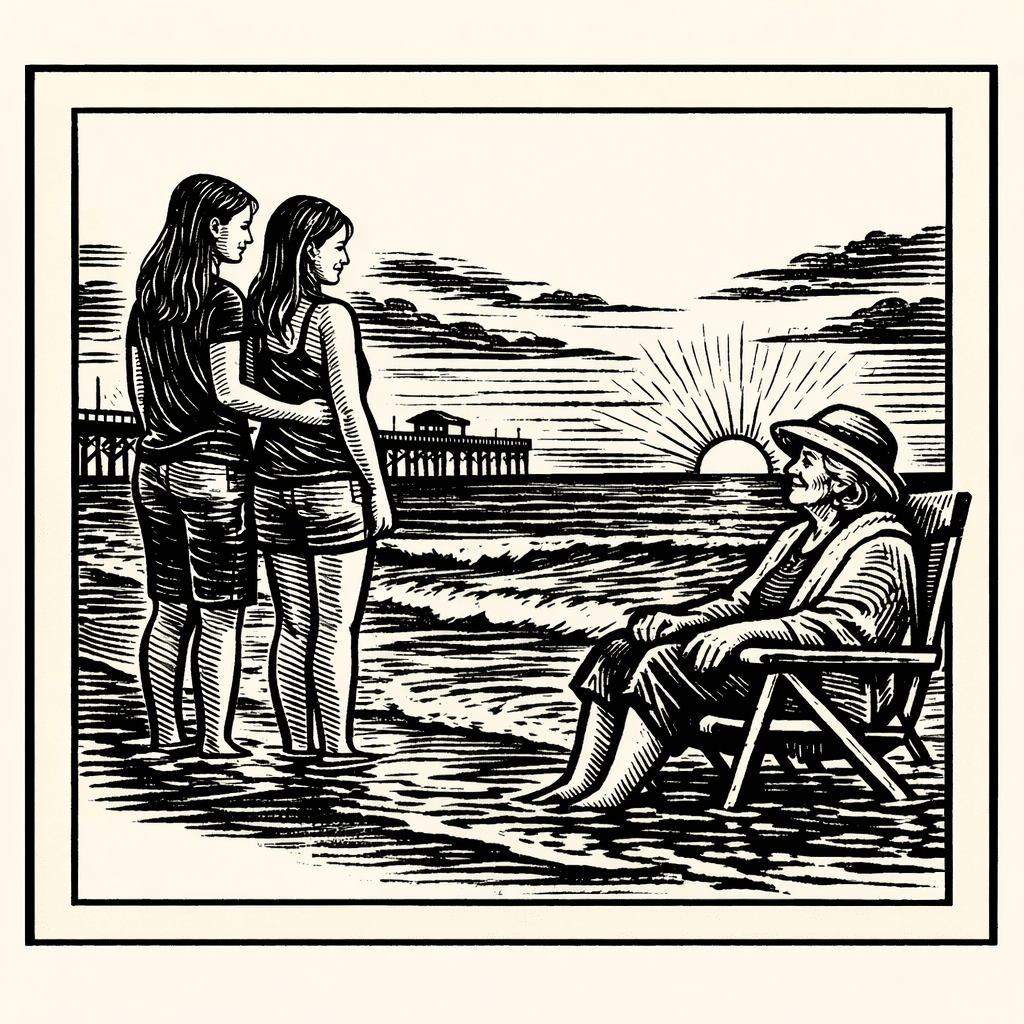
Nan woke up as the RV crunched onto the gravel driveway of Myrtle Beach State Park campground. “Let’s get your hat on Nan, it’s bright out here.” Brianna stuffed the water bottles and the blanket into the backpack. Stéphanie strapped the folding camp chair on her back and locked her arms onto Brianna’s. They lifted Nan onto the seat made by their arms.

“Check?” said Brianna.”

“Check,” replied Stéphanie.

They carried Nan’s scrawny body along the gravel path, between the swaying beach grasses. They kicked off their flip-flops and their feet sank into the coarse sand. Stéphanie unfolded the chair where the ocean lapped against the shore, and they lowered Nan into it. Wavelets licked at her ankles.

The stout timbers of a long fishing pier, silhouetted by the setting sun, paraded into the ocean. The rippling periwinkles and quicksilvers of the water fused at the horizon where the sky was stained with flaming streaks.

“This is heaven,” Nan sighed. “Myrtle is a symbol of love. You can never get enough love.”

Brianna and Stéphanie wriggled their toes, magnified and wobbly under the water.

“I was eighteen, with smooth skin and strong arms like you two.” Nan paused to catch her breath. “When I got pregnant.” She let out a rattling sigh.

Brianna glanced at Stéphanie. Pregnant—this was a new story.

“I was a counter girl in the glove department of Ogilvie’s, my first job. I loved him. It was my first time and I didn’t know any better.”

Married man I bet, thought Brianna recalling her ex-boyfriend, the pilot.

Nan leaned forward and drew in a breath. Her headscarf billowed about her neck. “I was sent away to the nuns—Les Soeurs Grises.”

Brianna pictured the nuns in their dismal grey habits with their dull Catholic minds creeping about their granite fortress on Sherbrooke Street.

“They said my baby needed a proper family, a family that would give him a better life.” A raspy spasm of coughing interrupted her.

Stéphanie stroked her back while she caught her breath.

Nan hunched forward and sipped in some air. “He was a boy, but I never got to see him. I named him Daniel. His birthday was June 24th.

“You’re kidding, right,” Stéphanie interrupted. “Does Mom know she has a brother out there? I have an uncle I haven’t met?”

Brianna launched her shut-up-for-now look.

Nan’s eyes glistened. Her breathing was laboured. She fussed with her scarf. “Your mother doesn’t know. I meant to tell her. There was never a good time.”

“That was the early sixties. No Morgentaler, no pill, no Plan B,” Stéphanie said, running out of steam.

Brianna snapped her eyes at her—this is where we need to listen.

“Promise me you won’t ever tell her she has a brother out there.” Nan stopped. The screeching of gulls drowned out the sound of her gasping breaths. “I know I held back some love from your mom, just in case…”

Fragmented thoughts darted around Brianna’s brain. Nan had rationed her love for her daughter, so she’d have some for her son? What had that done to Mom? Or to her and Stéphanie? They’d received only carefully limited love? What about her right to be a loving daughter when her mother didn’t allow it? 

Nan would go ahead and die. She and Stéphanie would be saddled with this unfair promise. She stared up at the circling, screaming gulls. The sun accelerated as it plummeted from the sky and sliced through the ocean’s edge. The air filled with the scent of pine and creosote.

It was after midnight when Brianna woke to the sound of the surf from the beach. She and Stéphanie were spooned together in the darkness. Brianna, ‘tho she was shorter, was always the big spoon, her body thicker and softer against Stéphanie’s angular one. When they were little, this was how they had waited, whispering, and wondering if Mom would come and kiss them goodnight—all that waiting.

She strained to hear Nan’s irregular gasping and snuffling. Nothing. The sighing surf crowded into the space that had been Nan’s breathing. She counted for two full minutes. Still nothing. She touched Stéphanie’s shoulder and whispered, “Wake up Stéph. I think she’s dead.”

“How can you know that?” Stéphanie’s body stiffened against hers.

“I can’t hear her breathing.”

“Should we check her pulse?” Stéphanie’s voice cracked.

Brianna sucked in a breath. “She’s dead, Stéph.” The words dropped into the darkness. They lay together, rigid and silent in the unwavering rhythm of the surf. And then Stéphanie’s fingertips brushed against hers.

“Think she knew she wouldn’t make it to Disney World?”

Brianna tightened her hand around Stéphanie’s. “I’ve heard that. Dying people deciding when they leave.”

“Maybe tonight was enough—the beach, the sunset, the three of us? Better than Disney World.” Stéphanie said in a whispery, wet voice. 

Brianna blinked into the grey shapes developing out of the darkness. She let go of Stéphanie’s hand and groped for the light. “We should check Nan,” she said dully.

Nan was lying on her back. A slack smile creased her mottled face. Her crêpey eyelids draped over her closed eyes. Her arthritic hands were warm but there was no pulse at her wrist. Stéphanie touched her index finger to her lips and then placed it lightly on Nan’s blue ones. She arranged the blanket around her face. “It’s like she did this on purpose, passing away on this narrow bed with us so close to her in this tiny RV.”

“She wanted to avoid seeing Mom again. Mom wouldn’t forgive her if she told her about Daniel. What would that be like, to be judged for something that happened so long ago?” She reached over and hugged Stéphanie. Neither cried.

“You don’t know that, Brianna.”

“I don’t know what I know right now.”

“We should call Mom now,” Stéphanie said.

“It won’t change anything. We need to figure out what to tell her. Let’s go home.”

“Are you crazy? We can’t drive across the border with a dead person in the back of an RV. We should go to the police.”

“Think of all the questions. The paperwork. Let’s do it this way.” And Brianna thought about her dad, that he would do the same thing.

“What if it doesn’t work? We’ll end up in jail,” said Stéphanie but she was already moving into the passenger seat.

They stopped at the first rest station to get ice. “Can’t do it Stéph. You have to,” Bree said.

Stéphanie positioned the weeping blocks of ice around Nan’s body and arranged the blanket over them. Her fingertips tangled in Nan’s coarse hair. She reached over and patted the loose tendrils of grey hair back into place against her forehead.

Brianna tested ways to tell her mother that Nan had died—Mom, sorry, we should’ve turned around after the first day. She imagined her mother’s granite face. And what if she told her mom about Nan’s baby? Would that fix anything? Would her mother wonder why Nan hadn’t told her before? And then, as they buckled up their seatbelts, Stéphanie started crying, a noisy, messy crying.

“Stéphanie, not now. I can’t worry about the border, figure out how to tell Mom about Nan, listen to your crying and drive. We’ll cry when we get home, when it’s not night and I’m not driving on the Interstate.”

Stéphanie reached out and touched her hand.

They reached the border crossing in Vermont after midnight the next day. The RV smelt like sweaty old T-shirts. The lilac blanket shrouded the still shape of Nan’s body. Don’t panic, please do not panic, Brianna intoned silently as she licked the soft pearls of sweat from her upper lip.

The Canadian border officer was older, older than her dad. Blinking in the fluorescent glare of the overhead lights, Brianna passed him the three passports, the navy jackets fingerprinted with her sweat. Brianna’s cheeks burned. Stéphanie sat quietly, her hair falling over her face.

“How long have you been away?” He smiled and his tone was pleasant.

“Two and a half days. We took our grandmother to Myrtle Beach. She’s been ill and wanted a short holiday.” The false tone of her voice scared her and inside her chest, her heart was exploding.

“Anything to declare?”

“No,” she squeaked, her lips tightening around the O.

“Where are you heading?”

“Home, Montreal, our mother’s house.” She braced her vibrating hands on the steering wheel. The beam of his flashlight flooded the back of the RV illuminating the bundle huddled on the small couch.

“She’s sleeping, sir.”

He panned the flashlight around the rest of the interior. And slowly, he stowed his flashlight and turned to the computer screen in his booth. The blood rushing to Brianna’s brain drowned out all other sounds. What was he doing that was taking so long? She wiped her hands on her thighs and re-gripped the steering wheel.

Finally, he looked up, tapped the passports together on the counter and handed them to her. “OK girls. You get her home safely now.”

Brianna turned the key in the ignition, but the engine didn’t start.

“Put your foot on the brake. Then start it,” Stéphanie whispered.

After the choking stall, they lurched forward into Canada.

“I’m calling Mom now,” Stéphanie said as she pulled out her phone. “I‘ll do the talking.”

Brianna glanced at the orange glow of the border crossing shrinking behind them in the rear-view mirror. A long sigh whistled out of her mouth.

It was two weeks after Nan’s death. Mom was slouched on a stool at the kitchen counter. Her eyes were rimmed with red. The counter was strewn with aluminum trays of partially eaten casseroles, empty wine bottles and an untouched fruit basket. 

Stéphanie, her face in her laptop, was distracted, checking out journalism courses. “Don’t tell Mom about the baby,” she’d insisted. “Some secrets are necessary. Less pain for everybody.”

Brianna made her mom a cup of tea. “Darjeeling, you like it,” she said as she placed the mug in her mom’s hands.

“I was a terrible daughter,” Mom said starting to cry for the third time that morning. “I was selfish. I took Nan for granted.” Tears plopped into the mug.

“You did your best. We’re all doing our best.” Brianna rested her hand on her mom’s forearm and considered the cost of keeping Nan’s secret. Which sorrow would linger longer—the loss of Nan or the pain of not telling Mom about baby Daniel? Her Mom pushed her hand away.

“I was afraid of her the whole time I was growing up. The whole time when she was doing so much with so little.” Mom straightened her posture.“Is there any sugar?”

Brianna heaped two spoonfuls of sugar into her mom’s mug. Would it help Mom to know that Nan had withheld her love in the hope of finding her first baby? Could Brianna console her mom while omitting the one thing that needed to be said?

“I could have been a better daughter.” Mom sipped her tea noisily.

“It’s a two-way street, Mom. It’s hard to love someone who won’t receive it,” said Brianna.

She saw the gap more clearly—the space between Nan and Mom but also the gap between her mom and herself. Brianna’s fixing and striving didn’t narrow the gap—wouldn’t make her mom more loving. And neither would be telling Mom about Nan’s baby.

Brianna saw that she was a good enough daughter—the best one she was allowed to be. She deserved as much care and kindness as she gave her mom. She’d continue loving her mom knowing she’d never receive much in return.

But for now, she’d clean up the mess on the counter and make lunch. “How about I make some grilled cheese sandwiches?” she said, collecting the take-out containers and pushing them into the garbage bin.

Filed Under: Watermarked Series, Writing Tagged With: Interlinked Short Story Collection, Writing

Almost Midsummer

July 17, 2026 by Carolyne Montgomery

After days of drought and watering restrictions, the lawn is as hard as iron, and the perennials are drooping, with only the hardiest persisting. But, last night, the metal roof chimed with plump raindrops. Finally, a welcome storm.

WATERMARKED

This month’s short story installment is “Saving Things.”

It’s the story of Lucie, the graduate student, with whom Michael had an affair. It explores the enduring effects of her exploitation by one of her professors. The story is set in Halifax, and I learned a bit about East Coast whales while I was writing it. I hope you enjoy it.

What am I reading:

Who doesn’t love reading Ann Patchett. I’ve written about her book The Dutch House, before. Her latest book, Whistler has similar charms—family disruption, grudges, regrets, and misunderstandings. Accidents and scars, physical and emotional. Secrets revealed or not. Forgiveness. I loved it. I think it is a perfectly balanced read, but some say it is too sweet. Keep writing Ann.

What I am listening to:

I’m listening to Angel Down, the 2026 Pulitzer Prize winner. “Angel Down plunges you into the heart of World War I and weaves a polyphonic tale of survival, supernatural wonder, and moral conflict.”

Kirby Heyborne, the narrator, does an excellent job of navigating the single, cumulative-sentence work. He is also one of the 166 voices in the audio production of George Saunders ‘, Lincoln in the Bardo.

I can’t remember how I stumbled on this work—possibly from an NYT review or why I chose the audio format. But the truth is, it is so bizarre (over-the-top) that I think I would have found it unreadable in print format. It’s All Quiet on the Western Front meets distorted metaphysical speculative fiction. The vivid descriptions of the carnality of World War I ( and I suppose any war—I’m thinking of the deliberate ongoing destruction of Gaza, Ukraine and Iran) are laced with alliteration, obtuse, improbable and fantastic similes, metaphors and symbolism.

An unlikely degenerate band of five anti-heroes, one of whom is a young boy, and all that means in terms of caring and needing to be cared for, has the common purpose of surviving the craziness. But can they overcome their own desires to protect the angel they have found tangled in barbed wire in no-man’s land?

You may recognize the author, Daniel Kraus, who coauthored The Shape of Water with Guillermo del Toro, which was made into the Oscar–winning film starring Sally Hawkins.

I’m listening to Angel Down in small batches as I drive around town. It’s so powerful, it’s all I can take. Like all strange and extraordinary things, this novel won’t be for everybody.

What I’m Watching:

Sports media have saturated my life for the last several weeks—The FIFA World Cup, Roland Garros in Paris and then Wimbledon. It’s a good job I’m retired and was able to attend a few FIFA daytime watch parties to wave the Canadian flag. It was agonizing to see the wonderful Felix Auger-Aliassime being eventually defeated by the wily Djokovic after playing a nail-biting five-setter at the Wimbledon Quarterfinal.

What’s Coming Up:

The Denman Island Readers and Writers Festival opens next week with another outstanding line-up of authors and workshops. Seems like it gets better and better each year. I’m looking forward to Maria Reva’s workshop, “Creating Tension through Character Networks.” Maria Reva is the Canadian Ukrainian author of Endling and Good Citizens Need Not Fear. (reviewed here in previous posts)

I’m off now to inspect the garden for signs of recovery after that fabulous and much-needed rainstorm last night.

Thanks for reading

Carolyne

Filed Under: Literary Festivals, What I'm Reading, Writing Tagged With: Angel Down, Ann Patchett, Audiobooks, Interlinked Short Story Collection, Maria Reva

Chapter 7: Saving Things

July 12, 2026 by Carolyne Montgomery

Lucie, a whale biologist in Halifax, is haunted by the death of her former lover, Michael. She struggles with academic recognition and her inability to commit to meaningful relationships. The chair of the department, Sully, accuses her of academic misconduct and assaults her. Despite her colleague Deborah’s advice, it is uncertain if Lucie will pursue charges against him.

Saving Things

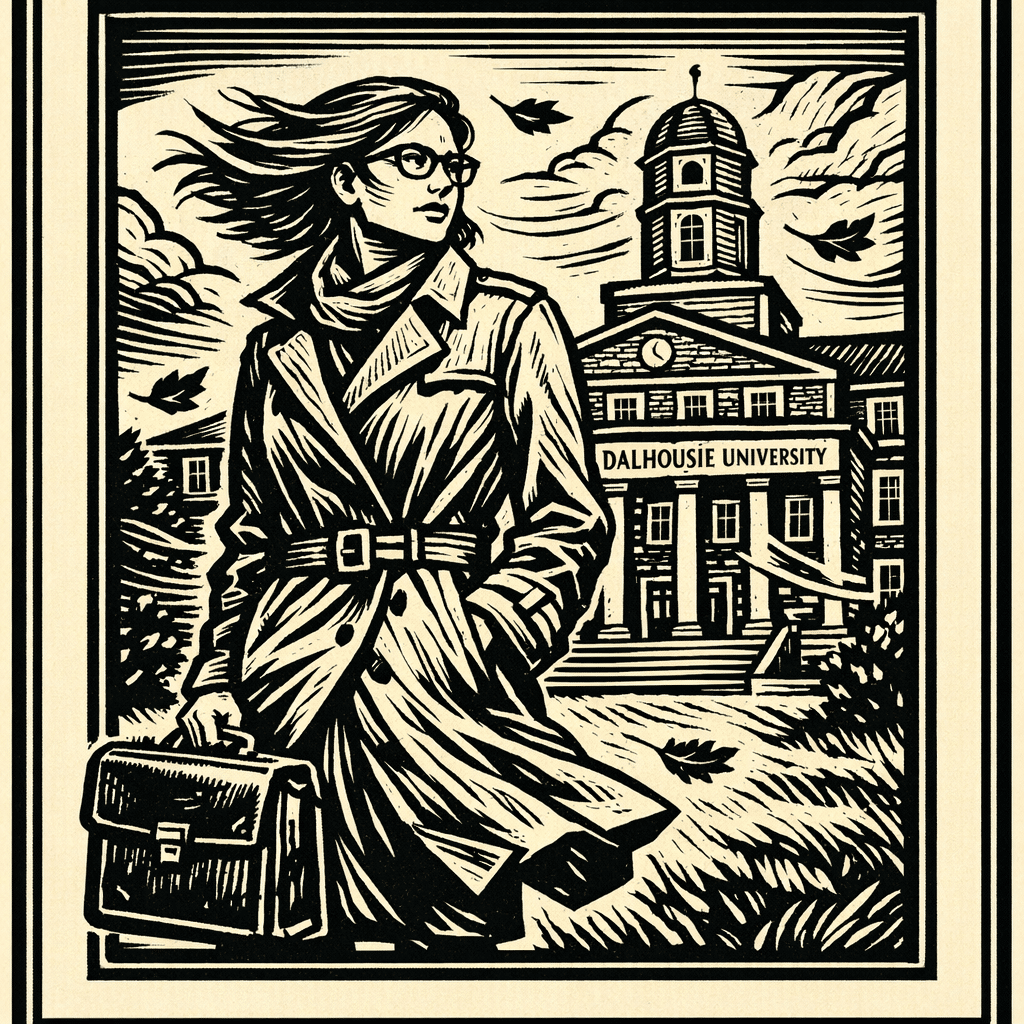
Yesterday, the department chair, Charles Sully, threw Lucie under the bus again, giving her two days’ notice to organize a recruiting talk for the Marine Biology undergraduates. Now, he’s insisting on another meeting this morning.

Despite Lucie’s recent promotion to Associate Professor, Scully treats her like a post-doc. And it’s petty, but when the new slide-in plastic nameplate for her office door finally arrived, her name was misspelled. Her name, her grandmother’s name, is Lucie, not Lucy.

She’s reviewing the slides for her lecture when an email from the department secretary at McGill lights up her inbox. Her ex-partner, Michael Sumner, is dead. Fifty-nine years old. Beloved husband of Claire and father of Brianna and Stéphanie. Humorous, collegial, and an outstanding mentor to his students. What else could they say? Irresponsible, philanderer, abuser.

The affair was a tragedy but not as terrible as her father dying of mesothelioma—all those years working with asbestos insulation. If her father hadn’t died that spring, if she hadn’t been so full of sorrow, would she have run away with Michael that June, seven years ago?

The alert on her phone rings. Time to get to Sully’s office.

“You’re late,” he growls. His shaggy beard and high forehead remind Lucie of the portrait of Melville in her copy of Moby Dick. She perches on the low folding chair before his desk like a schoolgirl in the principal’s office.

“First things first. The news about the death of Michael Sumner this morning. Sorry. I didn’t know him as well as you did…”

She flushes. Sully knew about Michael here at Dalhousie? Well, departments are small, and people gossip. She shouldn’t be surprised but the way he is staring at her is off like he’s making some kind of decision.

“But that’s not why you’re here. I’m assigning you the first-year biology course starting in January. Your teaching portfolio is thin for an Associate Professor.”

Thin. Really. Since she began to teach five years ago, she’s picked up more lower-level courses than any other staff. Endless batches of first years bullying her for higher grades. “That’s not fair. I’m more than qualified to teach 300 and 400 series courses.” Her tone is high-pitched and whiny, the opposite of how she wants to sound. 

“It’s not for discussion and what about tomorrow’s lecture? You’re prepared?” His lips tighten as though he’s suppressing a smirk.

“Of course.”

She feels the same uneasiness she had around Michael—all those edgy criticisms. She sits up straighter in the chair and stares past him at the pretentious painting of the fully rigged, tall ship hanging above his desk. Be agreeable. “The sooner the undergrads consider graduate work the more likely they are to commit to further study. A postgraduate program is essential to advancing the research of any department.”

“You’ve been enjoying the advantages of having PhD students,” he says steepling his fingers under his moustache. “All those first authorships.”

Her heart slams about inside her chest as he scans her face for a reaction. “I stand by the roles I’ve had in all my publications,” she replies coolly. But is she missing something? Has someone complained?

“It’s my responsibility to ensure the ongoing academic integrity of all the members of this department. You’ve been warned,” he says waving his arm towards the door.

She gets up, forcing herself not to run, not to trip over her self-doubt.

“Expect to see me at your lecture tomorrow. I’ll be evaluating the presentation for your teaching file.”

The news of Michael’s death and Sully’s insinuations have shaken her. That afternoon at coffee, she confides in her older colleague, Deborah.

“I’ve worked so hard. Teaching. Research. I deserve a medal for running all those 100 and 200 series courses.”

“Patience, girl. How old are you, mid-thirties? Already an associate professor. I’ve been here for two decades, stuck in an adjunct position,” says Deborah. “Undergrads around here get more respect.”

Lucie nods. “The Canadian abstract deadline is coming up. I’m behind with the analysis of my Bottlenose cortisol data. And I got stuck with that last-minute lecture at lunch tomorrow. Did Sully ask you to present?”

“Yes, and I told him no. I’m not at the stage in my career where I need to impress anyone. He’s not bullying me.” says Deborah, applying lipstick.

Lucie stares at the tan lipstick smudged on the corner of Deborah’s upper lip but doesn’t know her well enough to mention it. She’d sound paranoid if she mentioned Sully had implied she was stealing her PhD students’ work.

Lucie picks up her coffee cup and papers. “We’ll be late for the staff meeting.”

It’s evening and Lucie meets her boyfriend, Sam, at the local pub. He’s a speech therapist, who works with hearing-impaired kids. Sam is five years younger than her, newly thirty. But at least he isn’t one of her students.

They share some french fries. She nibbles four of them—Michael’s voice in her head—Don’t want to get fat, do we? But all his controlling didn’t work. He’s dead. She hasn’t told Sam about Michael or the hold he had over her during the nine months of their affair. The house band starts.

“Come back to my place. We’ll talk?” Sam signs as he licks the foam from his beer off his upper lip. “Friday night sleepover?”

He’s teaching her American Sign Language and Lucie loves it when they practice. She shakes her head and signs back, “I love you.” He’s allergic to her cat when they sleep together, they go to his place.

Her signing vocabulary is fragile and she must think more carefully before she signs. When flustered, she forgets the gestures but she likes the idea of another way to communicate, to be better understood. “I have that lecture to give tomorrow,” she says, emptying her glass of house white. “I’ll come over after.”

“Walk you home then,” he says, frowning below the brim of his toque.

They walk past the flickering neon sign of their favourite restaurant to her apartment. Would Sam be more insistent that they move in together if she didn’t have the cat? For now, Pattie protects her from such a decision. Since Michael, she’s afraid of commitments, even to a sweetie like Sam.

Lucie lies in bed, watching the shadows playing on the dimly lit ceiling. Pattie’s purring competes with the clamouring inside her skull—thoughts of Michael and the vague threats from Sully.

She remembers the department’s December drinks party when Michael approached her. It was four o’clock, wet snowflakes slapping against the windows of the seminar room. 

“Hello there, Beluga-Girl,” he said. “Did your cortisol stuff get published yet?”

An electrical thrill buzzed through her. He knew her work. 

After glancing around the room, he ran his fingers through her hair. “Magnificent,” he said.

After that, nothing else mattered—the differences in status, their ages or his marriage with two teenage daughters.

Lucie oscillated between her infatuation with Michael and the misery of her father’s incurable mesothelioma. She had nothing left for her belugas, so that January, she quit her PhD.

Nobody tried to stop her from quitting. If one of her grad students wanted to quit, she’d do something. But nobody helped her. Not Michael. Not her thesis supervisor. Not her parents.

But her brother, Jake, did try. “Dad’s death is messing with your mind. Michael is a middle-aged, stagnant academic looking for a thrill. You’re a striving PhD student starved for attention. Don’t quit. Don’t go with him.”

It was June when she moved with Michael to Victoria where his former Ecology department welcomed him back. He promised Lucie there’d be orcas and humpbacks to study. He promised her she’d be more successful than she could ever be in Montreal. She believed him.

The weeks passed in Victoria and the relationship soured. She couldn’t find an academic job and worked as a server. She was clumsy and forgetful—the wrong temperament for the job. Michael mocked her stories of spilled drinks and broken plates. “Get a real job.” But she failed to find one.

That summer, on her birthday, he gave her expensive sunglasses from MEC—cool and perfect for ocean research. But then, he told her that his first affair was when his wife, Claire, was pregnant with their eldest child. Lucie yanked off the glasses, stunned by the satisfied look on his face. “Joy robber.”

Since she left Michael, Lucie’s resisted an urge to contact his wife, Claire, and the two daughters he’d abandoned—to apologize for the shabby adventure. Instead, she found the courage to approach a Dalhousie prof, a kind man now retired in the desert. She begged him to supervise the final two years of her PhD. The Beluga data set and her publication saved her sorry ass. She was lucky to get back on track and she’s not going to let a creep like Sully push her off.

She’s thirty-five now, too young for a full professorship but getting old for other things, like having a family. Since Michael, it’s difficult to trust anyone, even Sam.

She takes a sleeping pill and crawls into bed. She rubs the special place behind Pattie’s tufted ears as he burrows under the comforter beside her neck. Eventually, she falls asleep.

At the auditorium, Mary Cosset, the department administrative assistant approaches her. “Sully’s cancelled the usual dinner for the presenter—too expensive for an internal speaker. And he’s grumbling about the cost of the sandwiches and coffee I ordered for lunch.”

“I’m on Sully’s shit list. Hope this lecture will get me off it.”

Mary smiles as she reaches over and straightens the collar of Lucie’s blouse under her blazer.

This morning as Lucie made her latté, Michael was right there, his voice in her head. He’d been a jerk but taught her how to make a great coffee.

“Good job, Lucie.”

You’re dead, Michael. Leave me alone. I’ve got a presentation to give.

“Sure. But Sully’s on to you.”

What does he mean by that?

Lucie scans the auditorium—about seventy-five students, more than she’d expected. For sure, they know about the free food. She’s skipped more of these lunch lectures than she should have. She could have learned more about the department’s dirty details at these events. 

Sully’s chatting in the front row with his deputy, Winchester—ignoring her and everyone else. 

After his introduction, she adjusts the height of the microphone and begins. “First, a bit about belugas from my McGill years.” She starts the video of her research team in orange survival suits in a Zodiac tracking a beluga pod in the St Lawrence River. There’s the clip of her launching the blubber biopsy dart from the crossbow. Her first time. There’s a gasp from the students at the thwack of the strike and the dark blush of blood washing out from behind the dorsal fin. She’d been terrified she’d hurt the whale.

“Now on to the big guys. North American Right Whales are critically endangered. Less than three hundred and fifty left.” Michael’s voice interrupts her. “Tackling Sully’s research, eh? Bad choice Lucie.”

Lucie highlights the summer when seventeen Right whales died in the Gulf of St Lawrence from entanglement or ship strikes. “Our group’s research convinced the government to close the snow crab fishery and enforce slower shipping speeds. Cruise ship routes were changed. The docks at Charlottetown were deserted.”

She senses the students’ interest and describes the acoustical tracking buoy network monitoring whale calls, showing their location in real-time. “You can’t protect whales if you don’t know where they are.”

Lucie licks her lips and clears her throat as she finishes. “Thank you for coming. I look forward to meeting you on campus.”

Sully presses his lips together in that weird way again. He is smirking. He approaches the microphone. The students are fidgety, looking at their phones—likely eager to get out to the lobby and into the food.

“Dr LeBlanc, thank you for your presentation.” He continues. “We’re a small department, small teams cooperating in the labs, in the field and on the research vessels. I’d have appreciated a little credit for the Right Whale research you’ve presented today but nevertheless, I look forward to your next contribution to this lecture series.”

Lucie squeezes her fingers into fists at her sides. She had referenced his research, but she hadn’t agreed to more lectures. She needs to escape before she does something regrettable. She glances at Mary.

“I’ll bring a sandwich to your office,” Mary says pointing her down the hall.

It’s six o’clock and dark outside. Lucie is at her computer combing through her presentation. Had she forgotten to mention Sully? Everyone is attributed even that pre-med student who showed up for one week that summer. She’d included pictures of all the team members—the vessel crew, the technicians, the students, the lab assistants, everyone. For sure, Sully was the Right Whale guy but all the stuff she presented was after his time. It wasn’t his work.

A text. Sully. Meet me in my office, now. Is he going to apologize for embarrassing her at lunch? She’s afraid of what she’ll say to him.

Sully gets up from behind his desk. He must know how rattled she is. “You’ve had a bit of a free ride here so far.” His pointy teeth flash below his moustache. “I’m wondering how we can get along better. Help each other out.”

She stops just inside the doorway. He reaches behind her and closes the door. Everything feels wrong.

“You think you would have been awarded that MEOPAR grant without my endorsement? Or your promotion would have happened without my influence?”

“Think about it Lucie. Both the promotion and the grant, with your experience.” Michael’s voice again. 

“Yes to both. I exceeded all the criteria,” she says staring at Sully’s piggy black eyes. But Michael did have a point. It was extraordinary.

“My girl, that’s only part of it. You do the bare minimum of committee work, cherry-pick the simplest research projects and ride on the backs of your students’ work. You’re not fooling anyone.”

“He’s on to you, Lucie.”

Lucie steps back as he approaches even closer. It’s not true. Or is it? There’s always more work to do in an academic department.

“Without my advocacy, the committee would not have approved your promotion.” He reaches and grips her forearm with his thick fingers. A worn leather belt slung below his belly is holding up his baggy jeans.

Her eyes water.

“You need me. You need to appreciate my support.” He leans forward squeezing her shoulder with his other hand.

He was too close—the smells of pipe tobacco and drug store aftershave. His shirt is untucked now, falling over his belly. Disgusting.

“Get. Your. Hand. Off. Me,” she says in her deepest voice. “I’ll scream.”

“Go ahead. Everyone’s gone. It’s just us.”

Rage strengthens Lucie. He steps forward to brace her against the door. She lunges forward and knees him in the groin.

He pulls away, staggering and groaning, “You bitch,” he gasps.

She yanks open the door and bolts down the empty hallway.

Lucie’s boot heels strike the pavement as she strides home across the poorly lit commons. She shivers in the wind blowing up from the harbour. She texts Sam. She’s not going over. She doesn’t want to explain why she’s upset.

She’s confused. She hasn’t done anything wrong but a person in Sully’s position could ruin her career in a moment.

At home, she showers, swallows another sleeping pill and crawls into bed beside the cat. As she drifts off to sleep, she hears Michael. “Being smart isn’t enough Lucie. It’s a complicated system.”

It’s Friday morning. Lucie strides with her head down through the crowded, blue-glass atrium of the Marine Biology building. She crashes into Deborah.

“Whoa, girl. What’s up with you?” Deborah asks.

Lucie bursts into tears as Deborah steers her into her office and sits her down on the small couch.

“Sully,” says Lucie wiping her eyes with her coat sleeve. 

“His name was on the work he’d done, and it wasn’t on anything he hadn’t.”

Deborah looks unsurprised as Lucie, trembling, describes the assault.

“We need to go to the human rights office,” says Deborah powering up her computer. “I’ll get the contact info.”

“It’s he said, she said,” Lucie says. “Sully’s the one with all the power here. They won’t believe me.”

“What he’s doing is wrong and there may be others, Lucie. You have to.”

“I don’t think I can.”

“You know he’s wrong.” Deborah pushes the tissue box across her desk. “Think of all the shit we’ve survived so far.”

“I don’t think I have the energy to start over again. To go where? Memorial? Back to McGill? Lucie snorts into the wad of tissues.

“When this is cleared up, it’s gonna hurt Sully more than you. The allegation of harassment is enough to stall his career.”

Maybe Sully knew Michael better than she thought. Deborah must know about her affair with Michael too.

“Sully’s, not a nice man. It takes courage to go up against this stuff.” Deborah hands her a mug of instant coffee.

Lucie’s teaspoon clinks as she stirs the clumps of Coffee Mate. Courage. The last time she summoned that amount of courage was the August afternoon in the apartment, the day before she left Michael, the day he found her plane ticket.

Michael pushed up against her and backed her against the window blinds. He spoke, massaging each syllable as though he expected her to repeat what he said.

“Go ahead. Leave. Try to pick yourself up. It won’t work.” He tapped his finger on her breastbone. “You’re unconnected. I’m the one who’s connected. He pulled his finger back and locked his eyes on hers. “I’ll make sure you never get an academic job again. Ever. Anywhere. I’ll make sure of that until I die.” 

Shaking, she wrenched her gaze free from his. The bare-branched ficus tree stood in the corner, dried leaves littering the parquet floor around it. She left him the following morning.

Filed Under: Watermarked Series, Writing Tagged With: Interlinked Short Story Collection, Writing

Living with Hockney: A Farewell

June 15, 2026 by Carolyne Montgomery

There is a particular grief that comes when an artist who has brought you joy is gone. It’s not the same as losing someone you knew—it’s stranger than that, more diffuse. When David Bowie died, it felt like a creative frequency disappearing from the air—the loss of a connection to my younger self.

David Hockney died on Thursday, June 11th, 2026, peacefully at home in London, one month short of his 89th birthday. The art world has lost one of its most important figures. The media are awash with tributes, and I have lost something harder to describe.

David Hockney painting of living room with his two dashunds

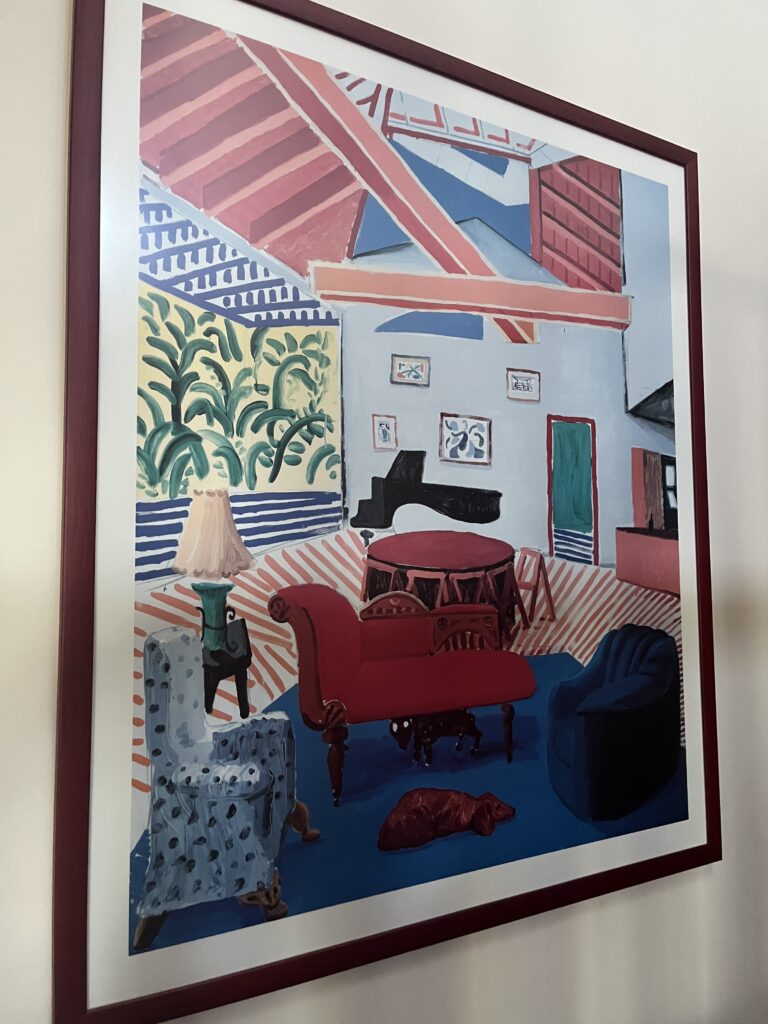
In my thirties, I bought a print of Montcalm Interior with 2 Dogs at the Art Gallery of Ontario. (or was it at the Musée de Beaux Arts?) I had enough money to get it properly framed—a maroon wooden frame and conservation glass. The print has been with me in several homes, a divorce, a procession of cats and one dog, the arrivals and departures of children, and all the other ordinary upheavals of my life. It’s still with me. Some things stay the same.

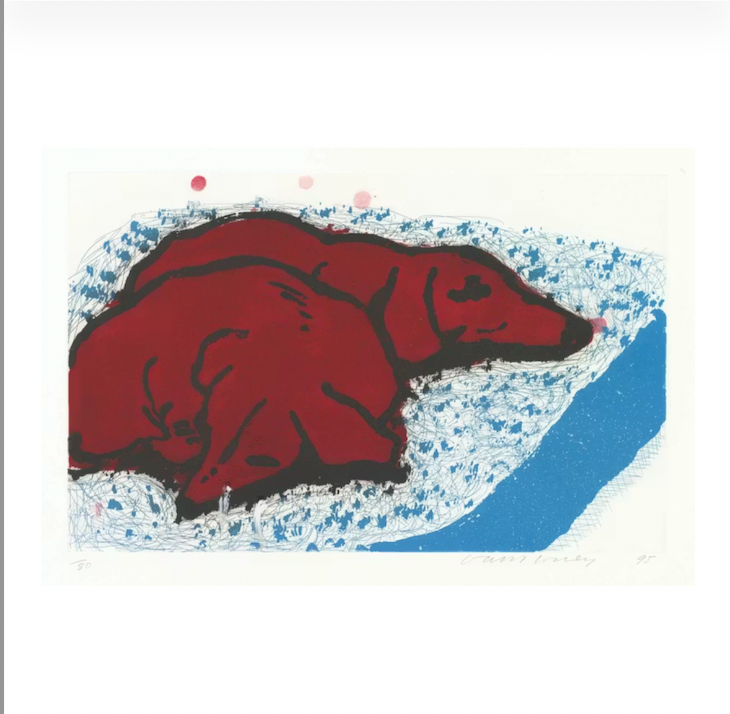
Painted in 1988, Montcalm Interior with 2 Dogs is a large, warmly lit domestic scene from Hockney’s California period. His two beloved dachshunds, Stanley and Boodgie, are central to the composition. Their relaxed poses radiate comfort and ease. Hockney painted his dogs with the same seriousness he brought to swimming pools and portraits. A dog dozing in afternoon light was as worthy of attention as anything else in the world.

His use of colour was extraordinary—bold, contrasting acrylic hues creating depth and dimension, the vibrant palette shaped by the Californian light he loved. Montcalm Interior communicates something simple: this is home. This is what a life looks like from the inside.

Born in Bradford, Yorkshire, in 1937, he was proud of his working-class origins. He arrived at the Royal College of Art in London and immediately made his mark, painting his experiences with total conviction. He moved through the world with a brave, unapologetic clarity—openly gay at a time when homosexuality was illegal in Britain. His homosexuality was woven into his work, in the tenderness of the portraits, in the bodies splashing into pools, in the intimacy of his interiors.

As artist Tracey Emin said this week, he was “a proud chain-smoking homosexual, who flew the flag higher than any other British artist.”

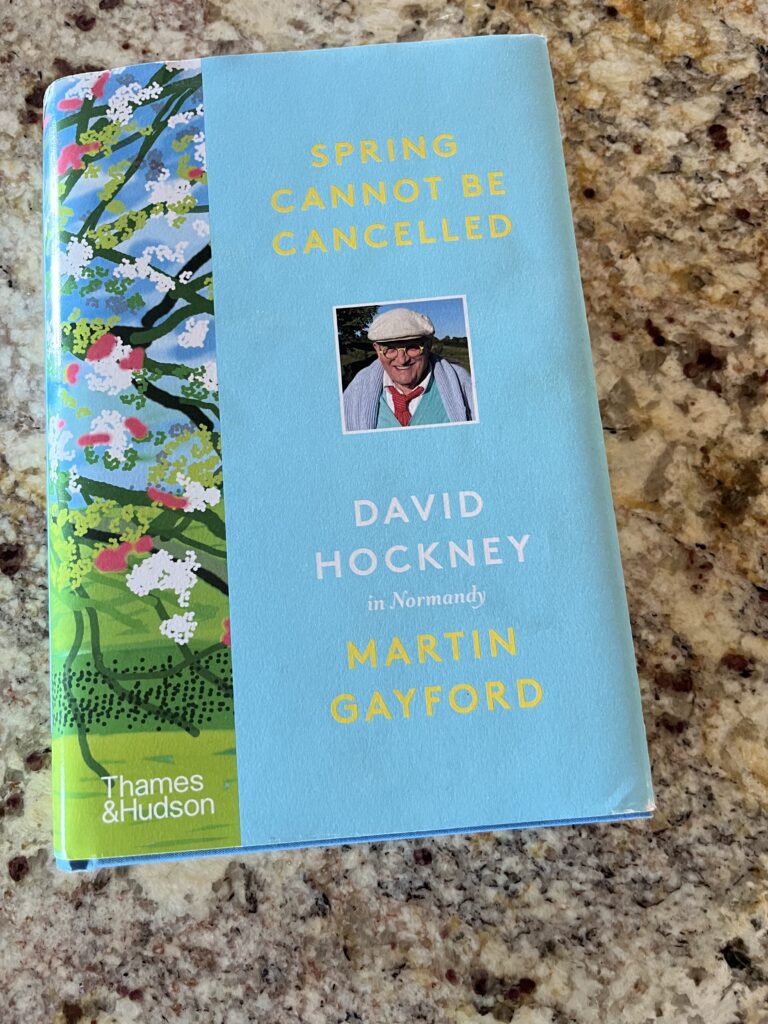
His creativity and curiosity led him to opera and stage design, expansive landscapes, immersive art experiences and a profusion of iPad art. During COVID, while in Normandy, he created the optimism of Spring Cannot Be Cancelled, a collection of correspondence with Martin Gayford.

He was, at his core, a humanist. His signature phrase was Love Life—and he showed it, in every brushstroke.

My print at the bottom of the stairs is more than it was before: not just a beautiful thing, but a memento of the person who looked at the world with more love and curiosity than most.

Thank you, David.

WATERMARKED

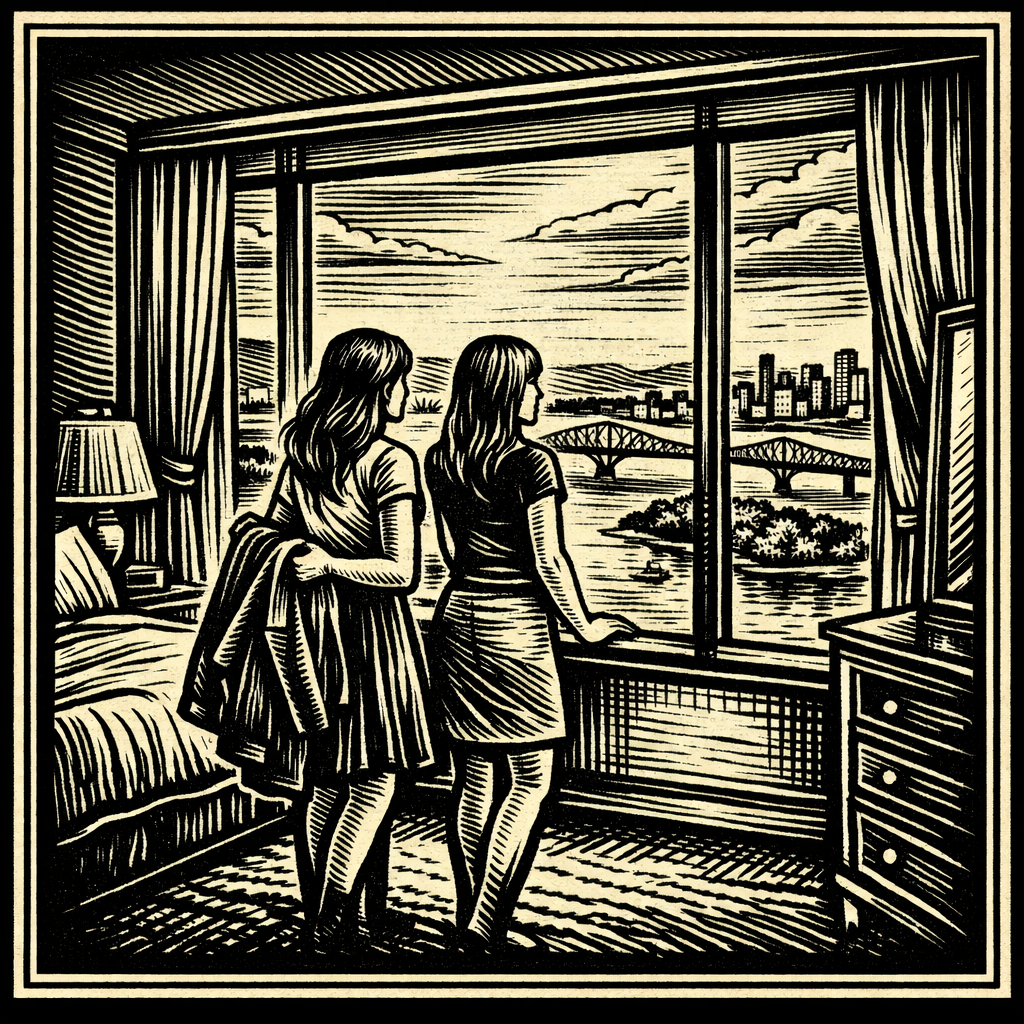
Woodcut of sisters looking out window

This month’s short story installment is “No One Will Be Looking At You.” Another heavy story as the sisters, Brianna and Stéphanie, cope with the death of their father and a secret is revealed. I hope you enjoy it.

Thanks for reading

I look forward to any comments. Any stories of your lost heroic figures and the reason they were of importance to you? If you think someone might enjoy this blog and my series of short stories, please share the link with them.

Filed Under: David Hockney, Loss, Watermarked Series Tagged With: David Hockney, Interlinked Short Story Collection, Loss

Chapter 6: No One Will Be Looking At You

June 14, 2026 by Carolyne Montgomery

When Michael dies suddenly, Claire reveals to Brianna that Michael has fathered a child, Sophie, with their work friend, Fiona. Brianna questions who her father was and resents her mother’s request that she keep the secret of her half-sister from Stéphanie.

No One Will Be Looking At You

Brianna’s first funeral was her father’s. She stood with her mother and sister, Stéphanie, on the steps outside McGill Chapel in the amber light of the late October afternoon. On the sidewalk below, students rushed past on their way to class.

The Holt Renfrew shopper had chosen the matching outfits—their mother’s idea. The itchy fabric of the V-necked dress gaped at her chest and strained over her bum and thighs. Her panties were cutting into the flesh of her buttocks. She’d have been better off wearing her flight attendant’s uniform. At least it fit her.

“Stand up straight, Brianna,” said her mother, Claire.

“And stop tugging at your hem?” Stéphanie added in her new irritating up-speak. Everything she said sounded like a question. 

“Stop picking at me. It’s hard enough already.” 

Nan, her grandmother, stood beside them in her black crepe, Chanel-style suit, the same one she’d worn at her husband’s funeral fifty–odd years ago.

The death of Brianna’s father was unexpected. Two weeks ago, one of the night cleaners found him slumped over his desk in front of his computer. The doctor explained it was a heart attack. He’d have turned sixty in November.

Dad and Mom had been separated for years. Brianna was sixteen when he had an affair with a graduate student, and Claire threw him out. He’d moved to Victoria with his fling, but six months later, after she’d left him, he slunk back to Montreal, to his teaching job at McGill and them. Mom refused to let him move back into the house, but Brianna was convinced her parents still loved each other—always asking her and Stéphanie sneaky questions about how the other one was doing.

Brianna and Nan made their way into the chapel behind Stéphanie, whose hand rested on their mother’s shoulder. With her hesitant steps, Claire looked like a crow with a broken wing.

Claire took small, careful steps along the flagstone floor of the chapel. The light touch of Stéphanie’s hand guided her to the front pew. At any moment, she’d lose her balance and fall over. It wasn’t the hangover from the sleeping pill she’d taken last night; it was the unexpected grief—grief for her unfaithful husband.

Last week, she’d met the rector, Anglican, a gentle person, who hadn’t known Michael. Claire sat quietly in the church office as her daughters described him; a sporty, funny, loving father. They’d left out his untidy infidelities.

Claire left out some things too—that Michael had fathered a child with their friend, Fiona. The girl was sixteen now. She’d also left out that she and Fiona were much more than friends but that was still hard to say. It was complicated, the three of them working together, being friends and at times, lovers.

A few years later, there was that incident with the graduate student.  She didn’t let Michael move back in. But she’d allowed him to come to the family cottage, to be with their daughters and to pretend that they were a normal family.

And now Michael was dead. The sense of unfinished business distressed her. Perhaps he was getting to the place where he was willing to make amends. They could have apologized to each other.

Two evenings ago, Claire and her daughters tried on the outfits she’d ordered for the funeral. Despite refusing to participate in Claire’s wardrobe plan, her mother had joined them.

“I have a suitable outfit, Claire,” Nan said. “I sewed it for my husband’s funeral. Ready-to-wear on an occasion like this?”

Oh Mom. A seamstress. A snob. Uncompromising. But she was enjoying the pizza that Claire had ordered.

Nan dabbed tomato sauce from the corners of her mouth with a paper napkin and spoke softly to Brianna, who sat beside her on the couch. She gave Brianna’s hand a purposeful squeeze. Her daughters shared their secrets with their grandmother. Claire didn’t have the patience for their dramas about boyfriends or unfairness at their jobs.

Had her mother ever told the girls that, in the beginning, she didn’t like Michael? She’d warned Claire not to marry him. Said Claire was marrying too far up, overreaching. It would only lead to trouble. But over the years, her mother and Michael became allies. They’d teamed up against her in a shared resentment of her accomplishments. After all, she was an internationally recognized, tenured professor with hundreds of publications. But truth be told, Michael and Nan had done most of the work raising the girls so Claire could have her career. Everything has a cost. And then Fiona. But that was after Michael had let her down so badly.

Claire watched Stéphanie slide into her dress. The jersey fabric of the wrap dress clung to her jutting hip bones. She looked fabulous. Claire still watched what Stéphanie ate. Her eating disorder was a lifelong condition, but she’d gobbled down an entire slice of pizza. 

“Your turn, Brianna,” Claire said, pushing the garment bag toward her.

Brianna struggled as she wriggled the dress up over her hips. “It doesn’t fit.” She slid her hand into the gaping front. “The jacket won’t fix this.”

Nan nodded. Claire felt the corners of her mouth tightening. Brianna wasn’t pulling her weight. “No one will be looking at you, Brianna.” No, they won’t. They’ll be looking at Stéphanie.

But now, they were in the chapel, seated in the front pew—Nan beside Stéphanie, then her, and Brianna on the aisle. They looked unified, dignified—a sort of solidarity against the shock of Michael’s death.

Claire’s eyes adjusted to the dim light. Her chest felt tight, and it was difficult to breathe. She interlaced her fingers with Stéphanie’s and let out a long sigh.

Brianna stared at the pewter urn containing her dad’s ashes resting on the altar table a few feet in front of her. Beside it was the picture of him smiling, his curly chestnut bangs draped over his forehead. It was Stéphanie who’d taken the photo—the final weekend they’d been at the cottage. She’d also chosen the pointed, patent shoes crushing Brianna’s toes. She gripped her tongue between her teeth and wriggled her heels out of them. 

Last week, Brianna had met Stéphanie at Dad’s apartment on Nun’s Island to choose a suit for his cremation. Mom had refused to come.

She found Stéphanie standing in his bedroom, her fists on her hips, gazing through the streaky windows at the view of the swirling waters of the St Lawrence River.

“We walked across the river on the Escalade with Dad?” Stéph said.

More annoying up-speak—must be nerves. Brianna sniffed. “I remember. That Minke whale swimming upstream. It died.” She felt her face screwing up tightly in the way that was supposed to stop her crying. She retreated into the tiny bathroom, shut the door, and slumped onto the toilet seat. Abandoned on the edge of the spit-splattered sink were Dad’s worn-out toothbrush and a chubby tube of toothpaste squeezed in the middle. She dabbed her eyes with a tissue, flushed it down the toilet and went back out.

Stéphanie slid back the mirrored closet doors. “Not much here, Bree?” 

The hangers scraped as she pulled each one across the metal rod.

“What about this?” she said, holding up a navy-blue pinstripe suit.

“That’s not him,” Brianna said. 

“This tie?” Stéphanie held up a brown tie, patterned diagonally with dark blobs. If you looked closely, you could see they were perching birds. “Mom gave it to him. Birds, it’s how they met.”

“Never saw him wear that either,” Brianna said.

Stéphanie pulled his camel hair jacket off the mangled wire hanger. “The tie’s perfect with this?”

Brianna stepped closer and pushed her face into the lapels of the jacket. “That’s his scent, that oaky scent. She held up the sleeve. “Remember?”

Stéphanie sniffed the sleeve. Brianna saw that she didn’t. “No tie. The cream turtleneck he always wore,” Brianna said, her voice muffled in the fabric of the jacket.

Stéphanie found the crumpled turtleneck stuffed in his bottom dresser drawer. Her nose wrinkled as she held it up.

“Doesn’t matter Stéph, it’ll be fine,” Brianna said too sharply.

 “I’m just as sad as you are, Bree. He was my dad too.”

“Sorry.” She hadn’t meant to be mean, but she’d been closer to him. She’d understood him better than Steph.

But none of that mattered anymore. Dad and his clothes had been cremated. What was left of him was in that urn. She sat on the hard oak bench, tugging at her sweaty polyester dress and wishing she could hug him.

Claire glanced back at her friends and colleagues, murmuring among themselves as they filed into the pews. The air was thick with smells of polished wood and dusty hymnals. The organist was playing a mournful Bach piece she couldn’t name, the one the rector had suggested. What would Michael have chosen if he’d had the chance?

Nathalie, the department chair, caught her eye, making a warm half-smile. Claire spotted the cleaner who’d found Michael. And there was his uncle, Fred, ninety-four now, bent over his walker and shuffling up the aisle with his caregiver. 

And despite their argument last night, Fiona had come. She sat in the final row beside sixteen-year-old Sophia. Claire had begged Fiona to come, to help her get through the day.

“Sophia never knew Michael. He wasn’t in the picture.” Fiona said.

“Come for me.” Claire replied. 

Claire recalled the kerfuffle in the department seventeen years ago—Fiona announcing she was planning to get pregnant and raise a child single-handedly. Michael agreed to donate his sperm. Claire should have anticipated that Michael would get involved with Fiona after the baby was born. After all, he did have a history.

Sophia was two years old and in daycare. Claire and Fiona had resumed their weekly habit of coffee on The Main. The single parenting had been rough on Fiona. She had no other family and Claire and Michael helped when they could. At eight and ten, the girls were too young to be of any use babysitting. But they should have let the girls meet their half-sister—be included in raising her.

Claire was sipping her cappuccino, her mouth stuffed with apple torte when Fiona reached across the café table and gripped her arm.

“I can’t sit here chatting with you like nothing’s going on,” she said, more huskily than usual. “No more lying for me. I’ve been screwing Michael since before I got pregnant. I’m sorry.”

Claire choked on her pastry and lowered her cup. So obvious now. His willingness to father the baby. His attentiveness to Fiona. She lifted Fiona’s hand from her arm and stared into her moistening eyes. “And now?”

“We’re done now.” Fiona rubbed her eyes. “I was blinded by wanting a child and then so grateful. I needed him.” Tears flowed. “I was a project,” she whispered between sobs.

Fucking Michael. Again. With Fiona. Michael needing to be needed—then, the usual, he loses interest.

“I was using him to get what I wanted but …”

Claire took Fiona’s hand. “He has a way of getting what he wants, when he wants, Fiona.” Claire was angry but not at Fiona. Claire had helped set Fiona up. She was the victim—postpartum, single mother, home alone for those first nine months. Claire should’ve seen it coming. 

Fiona’s phone alarm rang. “Gotta go. Daycare’s gonna fine me if I’m late.”

“I’ll need some time, Fiona,” Claire said as she got up and hugged her tightly. “Let’s talk again tomorrow and all the days after that.”

They did talk more. They became a couple. But now Michael’s dead and the girls still haven’t been told about Sophia or even harder, Fiona.

The organ was quiet now. If Brianna thought of only breathing in and then breathing out, she’d get through this. Gregory, her dad’s childhood friend, delivered the eulogy, telling his favourite story, “He Just Wouldn’t Leave.” Dad had loved describing casting his father’s ashes into Georgian Bay, the horror of the greasy pile refusing to sink or drift away. What would they do with Dad’s ashes?

Her mother, who was not religious, had insisted on a reading of the 23rd Psalm from the King James Version. Brianna wanted to read the lyrics of a Tragically Hip song.

“It was Dad’s favourite song, his favourite band,” Brianna said. “Ahead by a Century.”

“It’s a rock song.”

“It’s a love song, Mom.”

Brianna refused to read anything else, so Stéphanie read the psalm in her stupid up-speak. “The lord is my shepherd” is not a question, Brianna murmured under her breath. Her brain brimmed with messy feelings–annoyance with Stéphanie for being such a show-off, sorrow for her mother and fury at her father for dying.

As Brianna squirmed on the bench to adjust her panties, she glimpsed of a tall woman sitting on the aisle in the last pew. Her oval face was strangely familiar. From Mom’s work? And beside her, looking like she wanted to bolt out the door, was a slender, white-faced teenager. Her hair was frizzy, ginger like Stéphanie’s but tugged into a bun. They had the same almond-shaped, emerald eyes.

A memory flashed through Brianna’s mind. She was seven. It was a summer Sunday afternoon, in a small park with wilted geraniums in the window boxes of the row houses surrounding the square.

She and Stéphanie, who was five, were playing on the swings near the fountain. Brianna glanced back to check for her dad and saw the woman with the oval face sitting beside him on the park bench. Her long legs were stretched out in front of her, and her hands were clasped over her pregnant belly.

“Hey, Brianna. Come here.”

Dad was smiling, drumming his fingers on the back of the bench.

The woman looked at her with shining green eyes. “You’re noticing my belly.” Brianna nodded. “Would you like to touch it?”

Brianna did but she squeezed her hands together behind her back.

“Take your sister. Get some ice cream,” Dad said, handing her a five-dollar bill.

“By ourselves?”

“By yourselves.”

But when Brianna was in the variety store, Stéphanie disappeared. “Dad, I’ve lost Stéphanie,” she panted as she ran towards the couple on the bench in the park.

He grinned and pointed towards the fountain, where Stéphanie was trailing her fingers in the water. Brianna worried that Dad would tell Mom that she’d lost Stéphanie. She worried that she’d forgotten to close the freezer in the store.

“Bree, you worry too much for someone your age,” Dad said.

“The Day Brianna Lost Stéphanie,” became one of his favourite stories. When he told it, he never mentioned the woman, Fiona. But the worst part was that Dad hadn’t understood how frightened she’d been.

The rector’s voice hummed in the background. Brianna twisted on the hard pew considering what Nan had whispered to her the other night on the couch.

“Well, your dad can’t harm anyone anymore, can he?” 

Brianna wasn’t sure what Nan meant. He’d hurt her on the ice-cream day and that summer he went to Victoria. And why did that woman, Fiona, and the girl with the hair like Stéphanie’s belong at his funeral?

The service was over. Claire, flanked by her daughters and mother, made her way down the aisle and out of the dim chapel into the afternoon light. They stood in a line at the top of the steps. Claire exchanged kisses and hugs with Michael’s colleagues and friends. She and Fiona shared a long embrace.

“Sorry about last night,” Fiona whispered in her ear. “Of course, Sophia should be here.” She patted Claire’s bum when they moved apart.

“Who was that woman?” Brianna asked rubbing her hands on her thighs.

“My colleague, Fiona. And her daughter, Sophia.” 

Fiona’s arm was draped around Sophia’s shoulder as if to shelter her from the day’s sadness.

“Her hair’s just like Stéphanie’s. Same green eyes,” said Brianna.

“But her posture’s terrible. So slouchy and sulky,” said Claire, relieved her daughters were through the sloppy teenage phase and concerned at what lay ahead for Fiona. “Fiona works in the department. And yes, Sophia’s hair is just like Stéphanie’s. They’re both lucky.” 

Claire stopped. There’s never a good time. She took Brianna’s elbow and guided her away from the remaining guests. “Brianna, this is important. I should have told you years ago.” She pulled her fingers through her hair and took a deep breath.  “Michael fathered Sophia with Fiona. Sophia is your half-sister.”

“A half-sister? said Brianna. “Is this a joke? Does Stéphanie know?”

“Not a joke, Brianna. And let’s not tell Stéphanie. Not today. And please close your mouth.”

Claire saw Brianna’s confusion. Deaths and funerals make you do reckless things. It was the wrong time and the wrong day to tell her, but there was no going back. She glanced at Stéphanie, swaying in her high heels and flicking her flaming hair about in conversation with Michael’s soccer buddies. “Come on, girls. Let’s get to the reception.”

Claire hurried the girls past the brass-handled doors and into the faculty club. The flowers and linens did look elegant. The two-tiered cake was beautiful—royal icing decorated with tiny marzipan birds like the ones on that tie she’d him bought years ago. She’d resented the extravagant catering costs, but the girls had insisted. Her lawyer assured her there was nothing to worry about. Michael’s wealth would come to her. But she’d never stop worrying about money. She’d inherited that from her mother.

And now Michael was dead, she’d have to re-examine everything. Re-examine her anger, her disappointment and her contempt for him. To find what—sorrow or maybe even forgiveness? But if she was being truthful, she wished for a different ending; for another chance to tell him that she had loved him, at least in the beginning. But she didn’t forgive him for abusing her love with all those infidelities. Would he have forgiven her if she’d told him about her love for Fiona?

Brianna leaned against the wall of the reception room. Waves of chatter washed over her. Claire tilted her head to signal that she should join her and Stéphanie in welcoming the guests. Not yet. She hadn’t caught her breath. She wasn’t sure if she could walk. She was drowning in disbelief and anger. Today was supposed to be about Dad. The loss and the grief. Not the day to find out about a half-sister. Claire. So cruel. Questions churned inside her. Had Dad loved Sophia as much as her and Stéphanie? 

Claire had misjudged the situation. She hadn’t meant to be cruel. Poor Brianna propped up against the wall. So serious. Misunderstood. Her life would be so much easier if she’d lighten up. Claire should have spoken to Stéphanie first. She might have been amused at the situation, after all, they did look alike. It had been a mistake not to tell the girls sooner. Claire and Fiona told them the same day they told Sophia about Michael. But she and Fiona weren’t ready to come clean about their relationship. The girls would have seen it. Muddy water under a rickety bridge. 

Brianna made her way over to join them. Good girl. She’s recovering. They’d stand together for the remainder of the reception to receive condolences about Michael.

But in the future, it would be up to the girls to learn how to manage life’s tough truths. Like fledglings being forced from the nest, they needed to grow up. She wasn’t responsible for their happiness. It was hard enough to find her own happiness. But she’d begin by ensuring she got a slice of that expensive cake before it all disappeared.

Filed Under: Watermarked Series, Writing Tagged With: Interlinked Short Story Collection, Writing

“The Lusty Month of May” (in the garden at least)

May 25, 2026 by Carolyne Montgomery

Watermarked

This month’s short story installment is “The Hummingbird,” a heavy story (trigger warnings for rape and anorexia) inspired by cautionary tales from my misspent adolescence. It’s the time-worn tale of a younger sister wanting to impress her older sister. It is one of the stronger ones in the collection. I hope you enjoy it.

Recognition for “Skywalking”

My short story, “Skywalking,” was e-published by the Victoria Writers’ Society in their publication, Island Writer, the Summer 26 edition. If you read the introduction by Valerie White, the editor, you’ll learn that there was a broad acceptance policy for this issue, but it’s nice to be recognized.

I like my two quirky characters, Harry and Edith, who meet in a charity shop in Victoria. Harry looks up to Edith but is puzzled by her choices and her expectations of him. (aren’t we all sometimes puzzled by people’s expectations of us?) Many thanks to Larry Bambrick, who advised me on the revisions.

The BC Masters Swimming Provincials in Kelowna

To mark turning seventy, I entered a swim meet. Like the slogan on the old Lululemon bags advised, “Do Something That Scares You…” It was slightly scary. I learned a lot at the three-day provincial event—when and how to warm up, where to leave my flip-flops and shirt, when to get up on the blocks and more. The experienced members of my team (The Sharks Masters) provided bottomless positive support. There was a lot of action, amazing athletes and a competitive vibe. I got to use the skills I’d gained by the time I hit the last event. There’s a lot more to learn, but yes, I’d do it again. Maybe as soon as November.

Reading and Writing

I’ve got a pile of short stories I should be revising. Instead, I’m negotiating with three fictional characters who might want to be in a novel. They’re busy considering the commitment to all those scenes and plot points and whether they want to change over the course of three hundred pages.

Meanwhile, I read Emma Donoghue’s Giller-nominated page-turner, The Paris Express. It’s a wonderful fin-de-siecle, clock-ticking, pot-boiler of a novel.

And now…

Back to the garden to catch up on all the pruning and planting I’ve delayed and deferred from last year.

See you in June, and thanks for reading.

Filed Under: Aging, Swimming, Watermarked Series, What I'm Reading, Writing Tagged With: Emma Donoghue, Interlinked Short Story Collection, Writing

  • Page 1
  • Page 2
  • Go to Next Page »

Primary Sidebar

Recent Posts

  • Dog Days of Summer
  • Chapter 8: The Road Trip
  • Almost Midsummer
  • Chapter 7: Saving Things
  • Living with Hockney: A Farewell

Archives

  • August 2026
  • July 2026
  • June 2026
  • May 2026
  • April 2026
  • March 2026
  • February 2026
  • January 2026
  • November 2025
  • September 2025
  • May 2025
  • December 2024
  • October 2024
  • July 2024
  • June 2024
  • May 2024
  • November 2023
  • October 2023
  • August 2023
  • November 2022
  • May 2022
  • March 2022
  • December 2021
  • October 2021
  • June 2021
  • April 2021
  • February 2021
  • December 2020
  • October 2020
  • July 2020
  • May 2020
  • March 2020
  • February 2020
  • January 2020
  • November 2019
  • October 2019
  • September 2019
  • July 2019
  • June 2019
  • May 2019
  • March 2019
  • January 2019
  • December 2018
  • October 2018
  • August 2018

Pages

  • A Swim in a Pond in the Rain – A Commentary
  • About Carolyne Jane Montgomery
  • Contact
  • Home
  • Independent Bookstores
  • Privacy Policy
  • Publications, Readings and Other Stuff
    • The Solstice Party
  • Signup

Copyright © 2026 · Carolyne Montgomery · All Rights Reserved | Support by Mastermynde