• Skip to main content
  • Skip to primary sidebar
  • Skip to footer

Carolyne J Montgomery - Reader & Writer

Carolyne Reads and Writes

  • Home
  • About
    • Socials
      • Facebook
      • Instagram
  • Watermarked Series
  • Publications & More
    • Indie Bookstores

Uncategorized

An Idea, an Image and a Feeling

October 9, 2021 by Carolyne Montgomery

After a hot and dry summer here in the Comox Valley, it’s indoor writing season. Time to drag out the notebooks with point form ideas and see what I can make of it all. I’ve spent some of the summer thinking about the things I have learned so far about the craft of Short Story Writing. I’ve learned that successful writing creates strong images in the reader’s mind. And who better to learn about creating strong images than a visual artist.

Painting by David Hockney

I’ve been inspired by the painter, David Hockney’s two collaborations with Martin Gayford, Spring Cannot Be Cancelled and A History of Pictures. Most of you will know David Hockney, the British modernist who’s shacked up his converted farmhouse in Normandy painting variously on his iPad and also with more traditional media–acrylic, ink, charcoal.

Martin Gayford is the art critic for The Spectator and has known Hockney for twenty-five years. The discussion format of the Spring Cannot Be Cancelled via shared emails and telephone calls between the two makes for informal and informative reading. The book is illustrated in hopeful, energetic greens and blues of rural spring scenes, trees budding or blossoming in partial abstraction.

A History of Pictures is an excellent survey of art history from the shared point-of-view of an artist and a critic. It was a great journey for me guided by the opinions and knowledge of these experts. From each discussion, I learned more about what to look for, what to see and how to see what was absent. And I think the same could be said about learning how to write fiction. It is an exercise in learning how to create effective mental images in scenes, learning what to put in and what to leave out.

There are several discussions about what makes a good painting. I would like to paraphrase and summarize what I think they were saying and apply the comments as a method for making a good short story.

Writing like Painter – Some ideas

Painters and writers can still get better at any age. This is reassuring to a late starter.

Don’t get filled up with ideas of what you think you should do or what someone else thinks you should be doing.

There must be a sense of something that has happened before the work and something that is going to happen after. (I love this one. A good short story has a past and a future)

The reader is looking for motion but they need to know who is doing what and where.

A single Point of View (POV, vanishing point in paintings) may not be the best choice. Consider parallel POV. Hockney is mad about parallel POV.

Consider the empty side of the table. Think of Da Vinci’s The Last Supper here. The fourth wall in theatre. Should you have a narrator or character that talks to the reader?

Characters need to be clothed in subtle costumes with credible postures and emotions. This requires understanding ambiguity

Each scene in a story must create an image.

And what is in that image?

There must be layers of light and shadow and movement.

Some movement is central and some movement is peripheral.

There should be structure and repetition.

Some things are revealed and some things are partially concealed.

The image must evoke a feeling.

The feeling must have meaning to the character and the reader.

The meaning provokes memory in the reader that will deepen the experience of reading.

When the work has layers, each re-reading of the work gives the reader a deeper experience.

So going forward

I’m looking forward to a productive writing “season”, thinking of David Hockney’s ideas and re-working my own.

What short stories am I reading?

My new short story crush is David Barthelme. It is quirky original stuff with great structure. Here is a link to his piece The School

I’m reading Australian writer, Shirley Hazzard’s collection of short stories and studying her contrasting sentences.

And, last spring I read A Swim in a Pond in the Rain, which is George Saunders’ close read of four Russian novelists. It’s loaded with wisdom I have yet to understand and requires multiple re-readings.

Happy reading and writing.

Filed Under: Uncategorized

The First Time I listened to Bob Dylan

June 13, 2021 by Carolyne Montgomery

A flurry of articles like cherry blossoms falling celebrated Bob Dylan’s 80th birthday in May. Enthusiasts poured over lists of the best songs, and the best albums, considering what should have been included or excluded. I was reminded of the first time I listened to Bob Dylan. Forget about when Kennedy was shot or 9-11, where were you when you first listened to Bob Dylan?

How to know if what I remember is true? You won’t. For sure, I was late to the Bob Dylan party. I came to “Blowing in the Wind” via Girl Guides and Peter, Paul and Mary and “Mr. Tambourine Man” via the Byrds radio hit cover version.

Top 40’s music poured out of my bedside teal-green plastic AM radio, tuned to CHUM 1050 Toronto. “In Toronto, it’s number one!” the catchy jingle rang out. Dylan’s 1969 hit was Lay Lady Lay and the thirteen-year-old me thought it was a pretty ballad with creepy lyrics. “His clothes are dirty but his hands are clean…” Did I know it was a Bob Dylan composition? I’m not sure.

In the summer of 1971, my brother and I and talked our dad into buying my sister a record player for her fourteenth birthday. It had a turntable and two detachable speakers with long spindly wires for better sound separation. Stereo sound was a new feature on LP’s. (long-playing records). I think the record player cost forty dollars, well over our budget. We didn’t bother asking my sister if she wanted a record player for her birthday. We needed a way to play our music at the cottage. What albums were we listening to that summer? Cat Stevens, Tea for the Tillerman; Janis Joplin, Pearl; The Band, The Band. We poured over the cover art and liner notes to find every detail we could find about the artists. The lyrics were rarely printed, we learned them or mislearned them (a mondegreen), by listening to the same track over and over and over.

My sister loved the Moody Blues, Days of Future Passed and the concept album, Tommy by the Who. We all listened to the Beatles’ Abbey Road and I wished that I owned Blue by Joni Mitchell. And when the cottage floor shook from our leaping up and down during “Jumping Jack Flash” or “Honky Tonk Woman” from The Stones, Through the Past Darkly vol II, we kept the stylus tracking on the vinyl by taping pennies to the top of the tonearm.

But that was usually weekend stuff. For most of that summer, mid-week, my sister and I were on our own in the wooden cottage with plywood walls and worn linoleum floors. The cottage had all the modern conveniences, running water, flush toilets and electricity but was on a large island in a lake in the Kawarthas in Ontario. The store and the payphone were a mile away on the mainland. We would gently paddle the canoe or roar across the water in “The Tin Can,” our aluminum boat with a 9.6 HP motor. Why 9.6 and not 10 HP? I never knew. Our parents were newly divorced–Dad, in town an hour away by car and Mom, in another country.

One the day I listened to Bob Dylan, my sister and I had crossed the water to go to the store to get maple walnut ice cream cones. We were wearing our summer uniform–T-shirts and cut-offs over our bikinis and calloused bare feet. It was my summer of Sun-In hair lightener. Blonds had more fun.

We met these two guys at the government dock. They were friendly and clad in the expected uniform of tight Levis 501 jeans, flapping plaid flannel shirts over tight T-shirts and steel-toed work boots. Their hair was long and shaggy. They were older, maybe even out of high school. Tall and skinny. Did they have names? Sure–single-syllable English names like Ken, Al, or Jeff or maybe even Bob–something like that.

“Do you like Bob Dylan?” one of them asked holding up the album he was carrying. And I knew I was supposed to, so I said yes but I would have been guessing if he asked me to name one of his songs. Which Dylan album was it? I can’t say for sure. But we invited them back to the cottage to play it. We clambered into The Tin Can and buzzed back across the lake to the cottage. It must have been a sunny day with calm water. It was a long crossing when the weather was bad.

One of them put Bob’s record on the turntable of my sister’s stereo system with the fake green leather covering and those separated speakers. They may have smoked a joint before they met us. They talked in slow, low tones. They sat together on one couch and my sister and I sat on the other one. We listened in silence to that rasping voice and those mournful harmonica sounds. I pretended to understand the lyrics.

And after fifteen minutes or so, one of them got up and turned the album over to the B-side. I don’t know that for sure. Maybe he played the B-side first? Not everyone is a purist. I’m not sure I recognized even one of the tracks. But I knew from how they nodded and listened that this music was important. It was like listening to a hymn in church. And that’s all we did. We listened.

Did we offer chips or pop or even beer? No. We wouldn’t have any beer until the weekend when my brother or father would arrive. Did they offer us a toke? I expect so. Did we take one? Maybe. And they stayed for the time it took to play the album. We didn’t dare suggest that they listen to our music. And then we ferried them back to the mainland and said goodbye. The whole event was just listening to music on my sister’s record player.

Since then, I’ve tried to figure which one of Dylan’s albums it might have been. By 1971, he’d released eleven studio albums and one compilation album, Bob Dylan’s Greatest Hits, the only Bob Dylan album I ever bought. He composed a lifetime’s work of enduring pieces in under ten years. And at least five of those years were spent recovering from a serious motorcycle accident. Maybe the album that day was Nashville Skyline with “Lay Lady Lay”? But surely, I would have remembered that song with the creepy lyrics and been awestruck by his duet with Johnny Cash in “The Girl from the North Country,” with its old British ballad, Scarborough Fair sound and shared lyrics.

And a few years later, Dylan played with The Band in Toronto’s Maple Leaf Gardens. At age seventeen, concerts in hockey arenas seemed like a good idea. I was a fan of both Dylan and The Band’s musical confluence of folk, country, blues, and rock. I’d found Music from Big Pink. “The Weight” and “I Shall be Released” are hymns to me.

Musicologists from the 2010 Rolling Stone Magazine list of 500 greatest songs credit “Like a Rolling Stone” from 1965’s Highway 61 Revisited as the number one greatest rock song of all time. (beating number 2, also from 1965, The Stones, “Satisfaction”). Dylan has fifteen songs on this list. And yes, this list was likely created by ageing white males who speak only English. What makes a greatest song? According to the hip-hop artist Jay-Z, “it just is”.

It’s fifty years later. Patti Smith has sung “A Hard Rain’s Gonna Fall” in Sweden at the Nobel prize ceremony in 2016. Bob and I both have grey hair. He’s sold his back catalogue and I’m mortgage-free. Does he fight of old age by pedalling a Peléton as he tours? And fifty years later, I’m still only familiar with those early years of his work and my favourite piece remains “The Girl from the North Country.”

Do you have a Bob Dylan story?

The Girl from the North Country

So, if you’re travelin’ in the north country fair

Where the winds hit heavy on the borderline

Remember me to one who lives there

She once was a true love of mine

Filed Under: Uncategorized

Do you need a bigger boat?

April 19, 2021 by Carolyne Montgomery

In the last days of March, I became obsessed with the mega-container ship, the Ever Given that was blocking the Suez Canal. For more details, here is a link to Amanda Mull’s piece from the Atlantic. In our instant information world, within minutes I could find out how the unsticking operation was going. It was a tasty crisis and a welcome distraction from the inevitable third wave of the COVID-19 pandemic.

Maybe you read about the Suez Canal Crisis of 1956 or listened to the opera, Aida? I learned Aida was not written by Verdi to celebrate the opening of the canal in 1869, although the opera did premiere in Cairo and yes there were camels. Perhaps now you know where Great Bitter Lake is?

There was the incomprehensible magnitude of the ship–a weight of 220,000 tons, the length of one empire state building, a width of nearly 200 feet wide and a capacity of nearly 20,000 containers. I became more aware of the magnitude of global shipping in general. And then all the memes including the stick-your-own-boat app, Ever Given Ever Ywhere.

The financial and geopolitical implications aside, I think this whole event is a valuable metaphor for getting stuck and unstuck in life.

Getting Stuck and Getting Unstuck

Here are some randomly ordered thoughts.

Getting Stuck

Did I really need a bigger boat? Who put all this stuff on my boat? Why did they (me) put all this stuff on my boat?

Should I have said NO? Or even maybe or not-at-the-moment?

What was I going to do with all that stuff anyway? Was I prepared to go this big?

Did I have all the experience I needed?

Did I have all the help I needed? Why didn’t I take the time to find the best help?

Is this the best time to be doing this?

Bad weather usually makes hard things harder.

Getting Unstuck

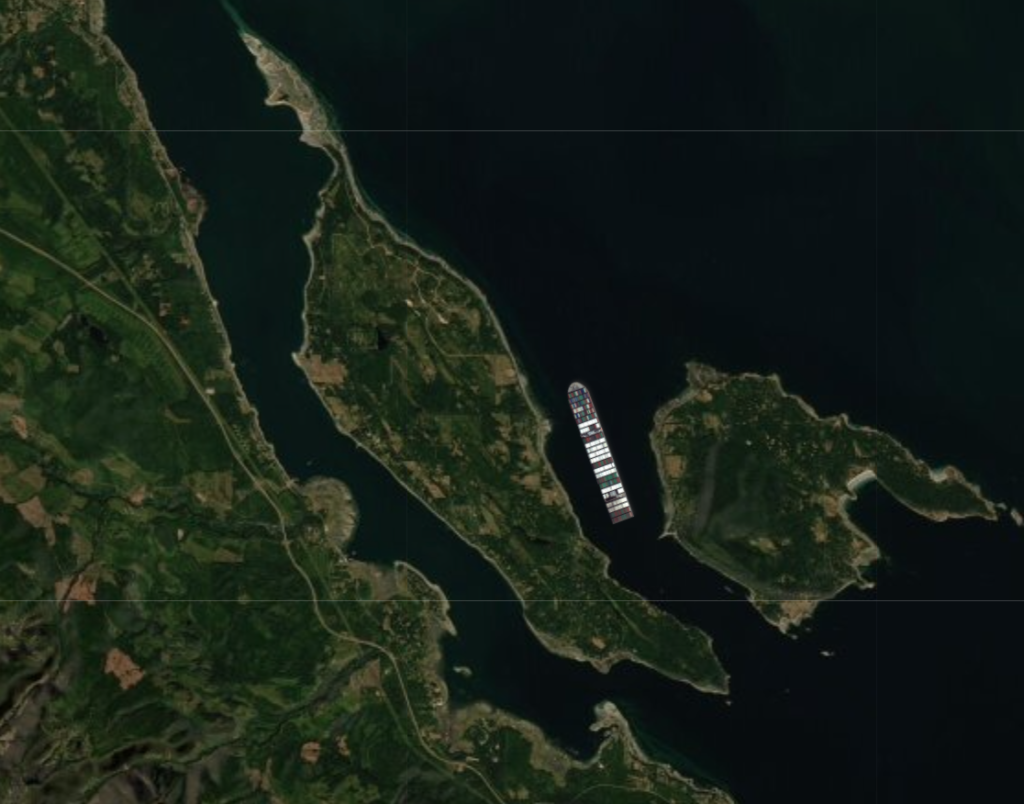
It happens. Forgive yourself for getting stuck. Keep perspective. This stick-your-own-boat image of the boat in Lambert Channel between Denman and Hornby Islands is not to scale. The vessel is much smaller than this and your problem might be too.

Get help. Get good help. Build a team. Work with your team. (and a team of friends and mentors is important to help you keep perspective)

Focus on the small changes that can make a big difference. (think of the brave little digger photos)

Celebrate the small changes. (honk your horn)

Stay curious and stay creative.

Unburden yourself from what you do not need to carry. (cast off unnecessary ballast and cargo)

Believe it or not, there are other people that can successfully replace you in some of the jobs your are doing now. Let them have a go so you can focus on what you need to be doing now.

Prepare to feel unstable as you unburden yourself.

Stay in contact with the natural world. Watching the waxing moon and the tides really help. Think about the impact of the six-foot tide in unsticking the boat.

Consider solutions that will not damage you any further.

After the crisis is over, check yourself for damage and give yourself time to heal.

Reflect on what you learned.

Say thank you to those who helped you get unstuck.

So…

Next time I’m stuck and I will get stuck, it’s part of life, hopefully I’ll remember some of these aphorisms. Happy unsticking if you need it and happy helping those who are.

Filed Under: Uncategorized

Some Things Do Not Translate

February 25, 2021 by Carolyne Montgomery

I’m grateful to have friends that read and share their books with me.

A few weeks ago, I borrowed the English translation of Before the Coffee Gets Cold by Toshikazu Kawaguchi. It is translated from Japanese into English by Geoffrey Trousselot. The author Kawaguchi adapted the book from their play which won the 10th Suginami Drama Festival grand prize.

Some of you may confuse your Murakami (The Wind-Up Bird Chronicle and others – we all have our favourites ) from the Nobel prize and Man Booker prize-winning, Ishiguro (Never Let Me Go and others). Haruki Murakami is Japanese and writes in Japanese but also translates English novels into Japanese. He does not translate his own works into English. Kazuo Ishiguro, although born in Japan was raised in Britain since age five in a Japanese family. He identifies as British and writes in English.

I emphasize these things as I learn more about the challenges of translating a work not only into another language but also into another culture. Some things do not translate.

Since I can only read English and basic French novels, I rely on all those decisions that translators make about content, tone, style, rhythm and pacing. What about the cultural mannerisms and styles, directness, indirectness that are prevalent in each culture?  How does an author work with a translator? How does the translator apply all the implicit and explicit cultural nuances of the native culture into the translated culture? How deeply must a translator understand both cultures?

From the little I found out about Geoffrey Trousselot, the translator of Before the Coffee Gets Cold, his main works have been technical or business translations. (Linked In) Is this his first literary translation? His minimalistic detached tone and style suit the constrained environment of the café and the restrictions of the time travel.

The novel is contained in physical space of small café, called Funiculi Funicula. There are nine seats, one of which is permanently occupied by a character who did not obey the rules of time travel. The five rules of time travel which include returning to the present before the coffee gets cold also restrict the possibilities. The setting and actions feel like a one-scene play with four acts. The door chimes sound “Clang-dong” as characters leave and enter the café like a stage.

The story is constructed into four chapters, each a tale of desire to time travel to reconcile with a loved one. Through spare rituals and repetition, and detached prose we learn of the four losses that motivate time travel. Characters recur and develop over the four chapters. Our assumptions and prejudices are challenged as more is revealed about each of them and their constraints.

The present will not change. And even knowing they cannot change anything, the lover, the spouse, the sibling and the parent still choose to time travel. They choose to manage their regret by spending only the time it takes a freshly brewed coffee to cool with their loved one. I wanted to time how long it takes before a coffee gets cold but there are too many variables. I would have to make it in the exact way described in the book by the character, Kazu.

And while I would also like to try Seven Happinesses Saki that is served, it made me wonder where the name came from. Fukurokuju which means happiness in Japanese is also the name of one the seven lucky gods in Japanese mythology. (this was from a google translated website!)

The last story of the four chapters is the most moving perhaps because it involves a mother and a child. But also because after the previous three stories, the reader more fully understands the relationships among the small cast of characters and the cruel limitations of the time travel. The present will not change.

It was hard for me as a non-Japanese speaker to learn the names and identify the characters and their relationships (sisters, spouses, in-laws and so forth) as they were introduced and re-appeared in each chapter. Like reading my Russian novelists, I had to write out Kazu, Kumi, Kei, Yaeko and Kohtake. And the translation is faithful to the Japanese custom of using last names at times which is even more confusing as the characters are sisters, or sisters-in-law or married.

The main theme in this novel is regret, a horrible but unavoidable human emotion. And the four stories amplify the futility of trying to avoid regret. Management of regret requires reflection and forgiveness and perhaps wishful thinking about time travel.

Read here for Murakami’s thoughts on translating The Great Gatsby into Japanese. He talks about translation as necessarily ephemeral, like dictionaries and language itself. Translation is done in the cultural context of the time and the translator.

What’s New?

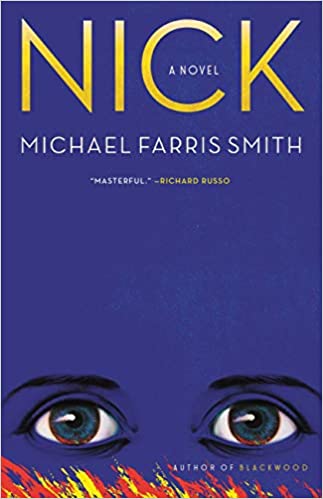
It’s hard me to think about The Great Gatsby without thinking of high school or Robert Redford or more latterly, Leonardo DiCaprio and Carey Mulligan. In the setting of the lapse of the American copyright to The Great Gatsby, I’m looking forward to reading the prequel, Nick by MF Smith.

And soon an Ishiguro release, Klara and the Sun which promises more of that dystopic after-burn of Never Let Me Go.

And for those of you in the Northern Hemisphere, I hope you are all enjoying the longer days.

Happy Reading and Writing.

Filed Under: Uncategorized Tagged With: Ishiguro, Translation

What We Can Imagine And What We Can Create…

December 4, 2020 by Carolyne Montgomery

“…the errands born from the gap between what we can imagine and what we can in fact create.” 

M. Cunningham The Room at the End of the World

It’s been a hard November. On the days when you can see it, the sun sets behind the mountains at four in the afternoon. I have a sense of unease and trudging futility in creating this blog. Who is it for? What does it mean? Do I or anyone else care?

I’m thinking about the gap between what I can imagine and what I can create. That’s the challenge as you learn a new craft. You become cruelly aware of what you don’t know. My writing, formerly intuitive and pleasurable is now under crippling scrutiny. Yet, like a toddler, teetering on a tile floor, I’ll stumble into this piece.

And it is foolish to ignore the effects of COVID on our creative efforts. We are all constrained by the restrictions and uncertainties of this more ominous second wave of infection. And at home, the weight of each repetitive routine rounds my shoulders. I’m reduced to counting.

I count the number of days and months it has been since I hugged certain loved ones and the number of grandchildren’s birthdays I have missed. (Three–A fairy tale number)

I count the new cases, hospitalizations and ICU admissions here on Vancouver Island and they are increasing. I count the number of vaccines in Phase III trials. (Thirteen) and feel the optimism as others are approved. I count the opinions on how the available vaccines should be distributed.

I count the soiled paper masks strewn about the car and crumpled into the pockets of my coats. I count the mask-wearing shoppers in the grocery store line-ups and the wavering spaces among us. I count the times I have been to a restaurant since March. (less than two hands worth) which leads me to count the times I have made yet another uninspired meal.

I count the deaths of people known to me or any of my friends (so far Zero) and I wonder when and for who this number will change? How close will this death be? Will we all know someone who has died?

I count the hours I spend doom scrolling, flicking through the news on my phone and wonder what it’s doing to my brain. I skim short stories without concentration. When I go out for walks. A nice lady reads Jane Eyre to me from my phone and somehow that is soothing. Listening to The Stand, by Stephen King was not.

Using Facetime, I read stories to my grandkids who are 13,000 km away. I count the minutes left in my Zoom meeting with my writing group as my brain begins to wander and I cannot control it. And in my Zoom music lesson, I count the couplets and triplets (Piz-za and Blue-ber-ry) and feel the rhythms relieve my tension.

I count the persons-with-positive-COVID tests flying into Comox from Calgary. Oh, the sorrow in Alberta! I count the times I have thought about various tests and their accuracy and how they might make our lives safer. (and I have to re-read it each time) Incredulously, I count the advertisements in my in-box of cruise lines offering discounts. Can you imagine that, going on a cruise? I’m counting on the members of my community to be as careful as I am.

I count the times when I have been less-than-accountable. Was that trip to the store necessary? I count the eggs and the amount of milk left in the fridge. (lots of both)

I count my blessings that the pool is still open and I can count my laps. I count the empty wine bottles waiting patiently to be taken to the recycling centre.

I’m counting my fears. I can’t understand what 64 million global infections mean. What is not counted? What will our new world be like? What are the global errands that need to be done to close the gap between what we can imagine and what we can create?

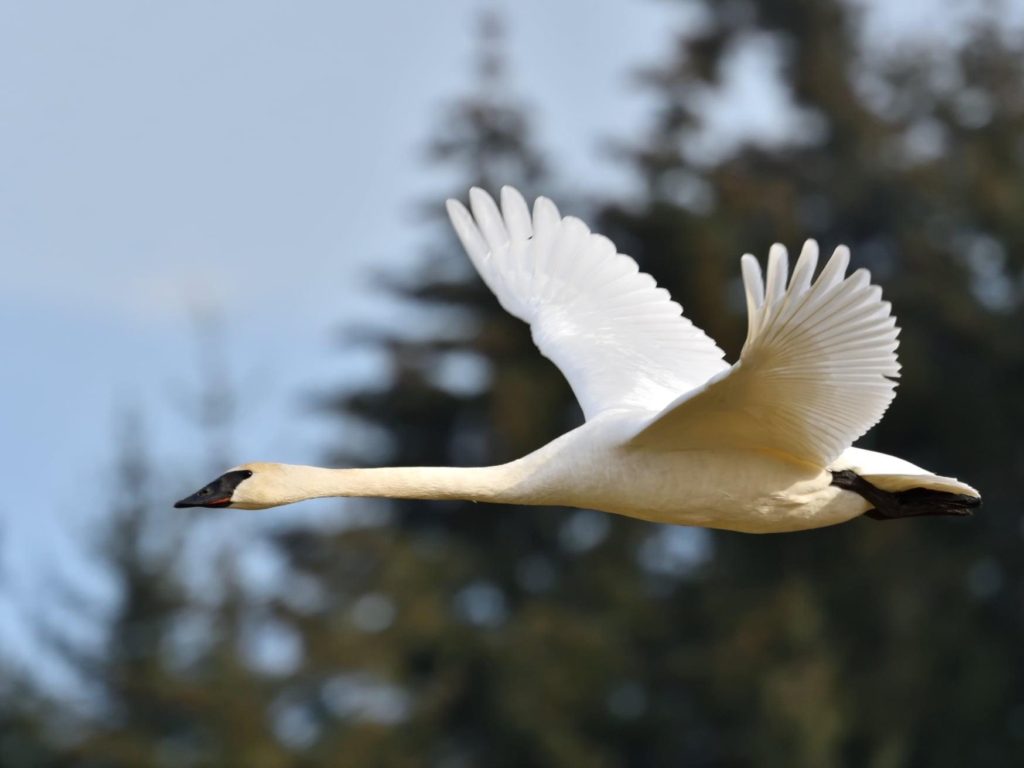
I’m counting the whirring hummingbirds at the feeder. (Two) I’m counting those long-necked trumpeter swans sitting in the cornfield today. (Two) I’m counting the scree-screeing eagles perched in the tallest hemlock overlooking the creek. (Two) I’m watching the full-moon high tides that are co-operating with the crashing swells and high winds to re-arrange the shoreline. The natural world is carrying on with its rhythms.

I am not counting the days to Christmas or to 2021 but I am counting the days to December 21st when the days will start to get longer again.(Eighteen)

I’m counting the number of revisions I have made on my recent short story (lots) and am thinking about that gap between what I can imagine and what I can create. I could try to measure the gap. But how? With what instrument and in what units? Would knowing that number make it an any easier or more pleasurable journey to learn how to narrow that gap? Instead, I think about those newly-born errands, those incremental skills that I need to practice to close that gap.

Please stay safe during this challenging time. Keep imagining and keep creating. Thank you for reading with me.

Filed Under: Uncategorized

And Now the Dark Exceeds the Light

October 16, 2020 by Carolyne Montgomery

The reluctant sun sheds its tardy rays on Brooklyn Creek as it wanders across the low-tide mud flat. The light catches the white plumage on the head of my Bald Eagle, splashing in the stream.  I hadn’t seen him for a few weeks.  The gossipy cacophony of the flocks of Brant geese, resting in the harbour from their ridiculous migration from the Arctic, seemed to have pushed him out of his routine.  The Chinook jumping in the Estuary excite the anglers. And after the heavy rains of last week, my mycologist friends tell me it is an outstanding year for Chanterelles. So many things to be grateful for.

Gravid dew drops outline the miraculous spirals and radii of the super-sized spider webs on the porch. I think of Charlotte, the arachnid heroine of E.B. White’s, Charlotte’s Web. (although these days I have been referring more to his The Elements of Style) I remember when I was a young mother watching the video with my two small children – two long decades­ after I had read the book. I remember my leaking sorrow at the thought of Charlotte dying without ever seeing her babies– all 500 or more of them. Her babies would learn of her genius and compassion only from the stories of Wilbur and her other survivors. I’m struggling with similar sorrows today.

Here in the Northern Hemisphere, it is past the autumn equinox, that immutable delimiter from where darkness will exceed lightness.  It’s a time when I count the days to December 21st when the light will return. It’s a time when I wake up with a dry cough and a slight burning in my throat and wonder for a minute if it is now my turn, my turn to have COVID.  And then I remember the smoke that filled the valley over the last few days and darkened the days even further with an hourless monotony. And that reckless bike ride I took despite the smoke.  My sorrow for the loss of summer deepens. And it is easy to wallow helplessly in our global sorrows, political and medical – and the two are not separable.

I am tired. My sorrow is a dignified affair managed with a procession of denials where I rely on distraction and doing to make sense of things – baking of banana bread, breathlessness at the top of the steps at the Spit or after laps in the pool,  – and then immobility in front of Netflix with a glass of wine. And I would prefer to be surrounded by the chaos and the authentic anguish of toddlers in their transitory moments of grief – from an attack by the coffee table, a dropped ice cream or a forbidden iPad – sorrows usually resolved by a hug or a kiss until the next time.

I cannot visit my adult children or my grandchildren. The two-dimensional spaces of Zoom and Facetime and the like will do but they are insufficient. And despite all my privilege and denial of the situation, I am exhausted. 

What to do? Rest. Carry on but permit my grief and allow my sorrow. Find strength in the beauty of the natural world outside my window. Await the arrival of the snow geese and trumpeter swans to the field stubbled with the remains of the corn harvest. Tell stories to my loved ones.   

Sunset over Comox Harbour

Filed Under: Uncategorized

  • « Go to Previous Page
  • Page 1
  • Page 2
  • Page 3
  • Page 4
  • Page 5
  • Interim pages omitted …
  • Page 7
  • Go to Next Page »

Primary Sidebar

Recent Posts

  • Watermarked Series
  • January in Comox
  • A Swimming Adventure in Barbados
  • How I spent my summer vacation
  • Finding Your Soul Speed: The Power of Poetry Memorization

Archives

  • January 2026
  • November 2025
  • September 2025
  • May 2025
  • December 2024
  • October 2024
  • July 2024
  • June 2024
  • May 2024
  • November 2023
  • October 2023
  • August 2023
  • November 2022
  • May 2022
  • March 2022
  • December 2021
  • October 2021
  • June 2021
  • April 2021
  • February 2021
  • December 2020
  • October 2020
  • July 2020
  • May 2020
  • March 2020
  • February 2020
  • January 2020
  • November 2019
  • October 2019
  • September 2019
  • July 2019
  • June 2019
  • May 2019
  • March 2019
  • January 2019
  • December 2018
  • October 2018
  • August 2018

Pages

  • A Swim in a Pond in the Rain – A Commentary
  • About Carolyne Jane Montgomery
  • Contact
  • Home
  • Independent Bookstores
  • Privacy Policy
  • Publications, Readings and Other Stuff
    • The Solstice Party
  • Signup

Copyright © 2026 · Carolyne Montgomery · All Rights Reserved | Support by Mastermynde