• Skip to main content
  • Skip to primary sidebar
  • Skip to footer

Carolyne J Montgomery - Reader & Writer

Carolyne Reads and Writes

  • Home
  • About
    • Socials
      • Facebook
      • Instagram
  • Watermarked Series
  • Publications & More
    • Indie Bookstores

Uncategorized

A Sporting January

January 30, 2019 by Carolyne Montgomery

Mount Ymir

I’ve spent most of January in the small town of Nelson in BC nestled between the Selkirk and the Purcell mountain ranges.

The idea was to downhill ski at the local resort, Whitewater and overdose on deep powder snow. The resort is nestled under the magnificent Mount Ymir (the peak is at about 2400 metres for those who wanted to know). After a stunning powdery three-day start ski-touring at Stagleap park near Salmo, we had to adjust the schedule to accommodate the sad event of less than 20 cm of snow in three weeks.  The locals say it is the driest January ever and of course last year it “puked snow” for the whole season.
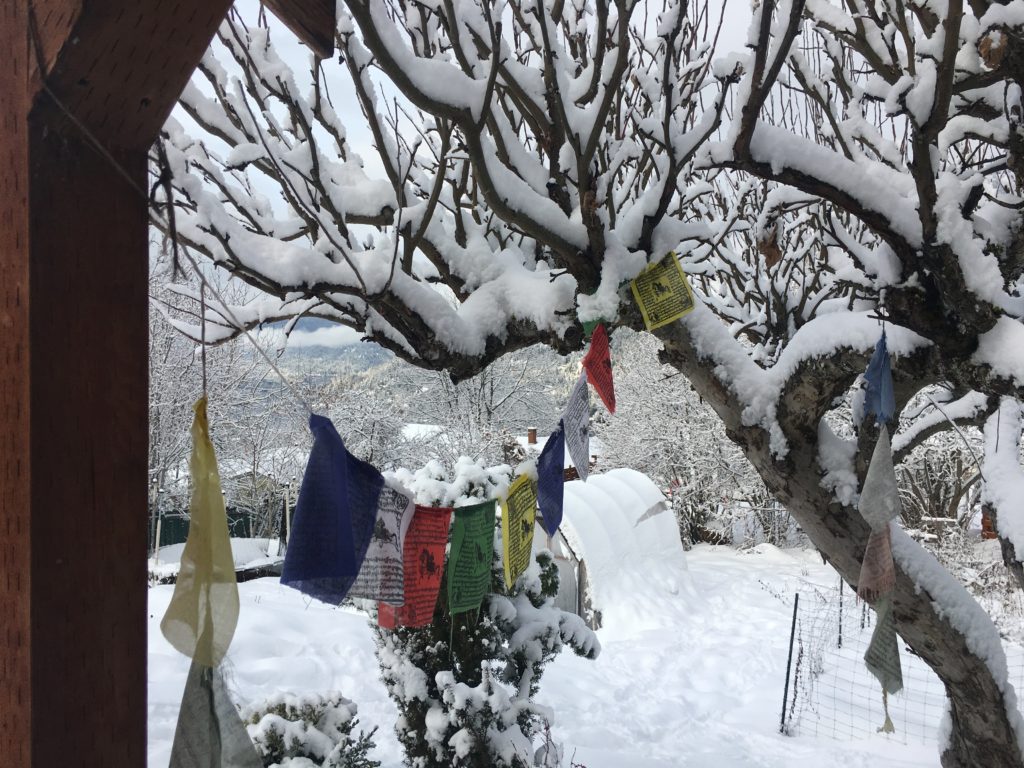
The view from the hot tub in Uphill Nelson

So I did more Nordic skate skiing including a full moon night ski. This is easier on my knees and better for my heart. I enjoyed the eclectic offerings of our new hometown – the recreation centre for yoga and swims, independent restaurants, micro breweries, the art gallery and scenic mountain drives to the hot springs at Ainsworth and the village of Kaslo.  In Castlegar, on the way to Red Mountain at Rossland – known to most of my generation as the home of 1968 Olympic skiing champion, Nancy Green, I marvelled at the conflation of the mighty Columbia River and the West arm of Kootenay Lake.

The area is dotted with charming small towns lined red-brick and wooden slatted buildings from the turn of the previous century when gold, silver and logging booms fuelled the economy and attracted those adventuring Norwegians and other speculating pioneers to the lands of the Syilx and Sinixt peoples.

The younger residents of Nelson vaguely adhere to a local uniform that features those Tasmanian all-weather boots, vanity toques that are worn indoors, flannel plaid shirts, jeans, felted slippers and cosy wool socks.  There is a daily practice of acceptance of the gender continuum and equity. My hatha yoga class is low on brand-name yoga wear and high on diversity.

Meanwhile, I nurtured my seasonal obsession with Open Tennis events by streaming too many Australian Open videos. I mourned the defeat of my idol Roger Federer to the upcoming Greek star, Tsitsipas.  I marvelled at the transformation of Raonic’s game by Ivan Lendl.

Serena at the AO 2019

I watched Serena Williams performing with supreme athleticism, dignity and grace as she continues to shoulder the burden of the various prejudices against her gender, the state of motherhood, her race and body type. Naomi Osaka, no the world’s number one is standing on those shoulders. My reading was reduced to scanning tennis writing from all sources and listening to live, radio reporting of the games.

I struggled to finish Esi Edugyan’s book, Half-Blood Blues but managed to crack open her latest, Washington Black.  I couldn’t settle down to read anything else. My own writing stalled during an attempt at a magical realism piece much longer than the short story length I am comfortable with.  I choked with the revisions and a deadline for a non-fiction sports piece. Yes, I am concentration challenged this month.  I need to keep checking the tennis scores.

I have taken the following remedial steps.

Inspired by the recent death of Mary Oliver the poet whose work I was introduced to last year, I have decided that I want to stay amazed and need more poetry in my life. I have signed up for Poem Daily.
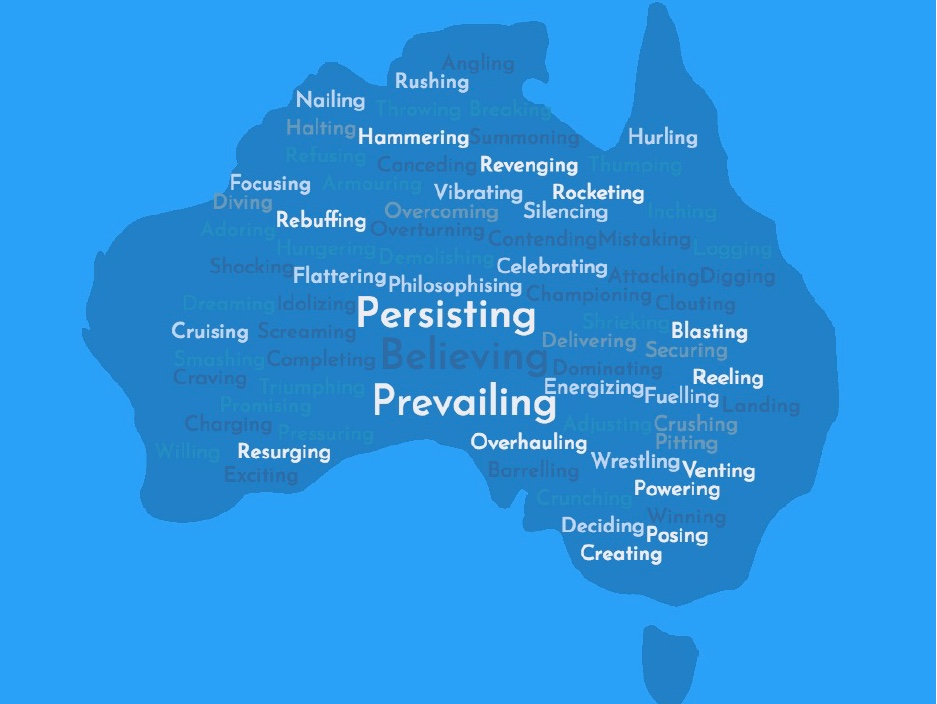
I have scoured the AO tennis writing for energizing verbs to apply to my writing as recommended by Joe Moran whom I have previously written about. I have converted this list into an inspirational graphic to celebrate all of writing, reading and tennis. Please read David Foster Wallace on Roger Federer in the link above for further inspiration for both writing and tennis. Thanks to Wordclouds

.

Filed Under: Uncategorized

In the Deep Mid-Winter

January 3, 2019 by Carolyne Montgomery

The cabin was dark and cold this morning and I scuffled about finding candles and so forth so that my partner and I could cope without electricity. The reliable wrought iron wood stove soon provided some heat and eventually coffee. Power failures are common here in the winter. The storm winds blow the second growth trees down onto the lines. Much later, we would learn how extensive the damage to the power lines on Vancouver Island was and feel grateful.

It was the Winter Solstice, the morning of the shortest day of the year. I was waiting for the cable ferry to resume operations so that I could take the two-kilometre journey across Baynes Sound from my small island to the larger one. All the island’s residents and visitors are all at the mercy of a winter storm – a storm with winds reported to be gusting from forty to ninety kilometres an hour.

Eventually, the pale and fragile winter light found its way into the cabin. The candles became useless. I picked up my book, Milkman by Anna Burns and started to read.

Menacing deep green-gray swells filled Baynes Sound and lurched northward. The sky was filled with featureless deeper gray cloud.  There were no signs of the flocks of winter seabirds that take up winter residence in the usually calm bay.

Eventually, we left for the ferry to go into town, Comox that is.  These days I tend to avoid the acquisitive crises of the “Christmas Season.” I have recalibrated my material expectations and hopefully those of my family and friends. The exceptions, of course, are good food and wine. The planned trip to Comox was nearly necessary – food, wine, a swim and to watch a hockey practice of the Swiss Juniour Team. OK – that’s not me but it was on the list of things to do.

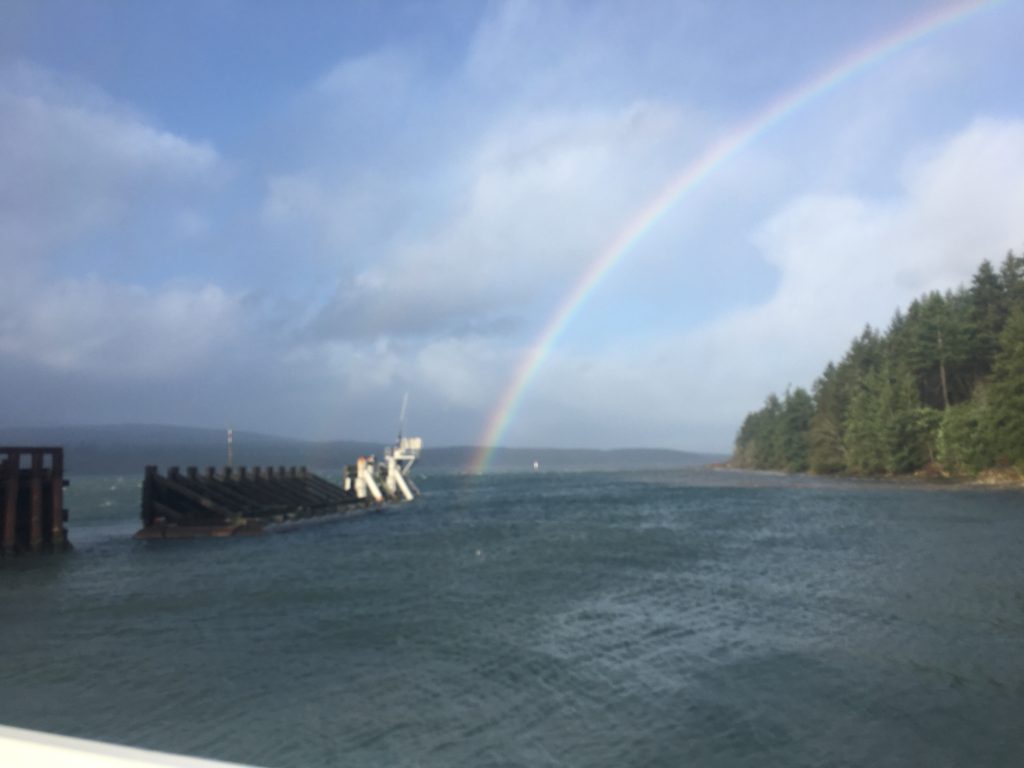
We help two other two drivers pull the fallen tree from across the road and drive to the ferry dock. The island is more exposed here than on the north end. Foaming driving angry white-capped waves fill the crossing. They splash, crash and smash against the dock rails and create pulsing sheets of fine spray. The wind catches these sheets, blows them across the pier and for seconds the air-born water obscures the flapping flags on the shrouds of the Baynes Sound Connector, the cable ferry.  My glasses are dotted with droplets that if left to dry will become crusty flakes of salt.  We learn that not only is the sailing of our small vessel impossible but that all the big ferries between the island and the mainland are cancelled too.

The sun comes out and there is a magnificent rainbow in the north that arcs across the brightening sky from the east shore of Vancouver Island. The clouds break up and hurtle north. The wind buffets about the solitary seagull that is possibly hardier or hungrier than the others. I imagine that the eagles are grounded, hunkered down and huddling in lower safer perches. A loose blue plastic barrel sails by on the surface of the water, tumbling in the chop as it is swept to shore. A fishing boat rockets by with a similar momentum and hurtles toward the safety of Comox harbour.   Mount Washington is still shrouded by all of clouds, fog and rain. Hopefully, some snow is falling at the very top.

There will be no ferry crossings now. We wait for the weather to improve and I resume my reading.

Milkman by Anna Burns is this year’s Booker Prize winner. It is a story told in the first person voice about a Catholic adolescent living in the civil war of Northern Ireland in the mid-seventies, a victim of ”religious geography” and long before the Good Friday Agreement of 1998. 

The failure of the protagonist’s strategy of non-participation by “reading-while-walking” is the main thread of the story.  She tries to escape the horrors surrounding her by reading exclusively novels written before the twentieth century.

The author does not give any of the characters Christian names that may traditionally Catholic or Protestant but rather they are known by their relationship to the protagonist or their role in her world. There is first-brother-in-law, Tablets girl and those non-conformists who are beyond-the-pale. The Pale or English Pale was a medieval English community in Southern Ireland.   Some of the characters names evolve as the relationships change, for example almost boyfriend.  I enjoyed the chorus of the “wee ones,” her three still-innocent younger sisters.

The prose is populated with strings of compelling neologisms that provide powerful promulgation and yes, stuff happens – “staying, ordering, commanding, warning” and “depravity, decadence, demoralization, dissemination of pessimism, outrages to propriety.”

The story addresses tribalism, misogyny and the fluctuating morals and norms of a community at war. The author examines the distortions of everyday acts and the meaning of language where the abnormal and immoral are normalized in the setting of civil war.  Rumouring and intervening are sanctioned actions. Finding a cache of weapons in your coal cellar is expected and objecting to it is treason. The community struggles with the possibility that a non-political normal murder may have occurred among them.

A powerful stalker who, without touching her, systematically violates her mental and physical health erodes the protagonist’s identity and independence. The protagonist postulates her society has not learned to identify shame but rather substitutes fear and anger to avoid confronting that terrible emotion. The resulting tribalism, hatred and violence are viewed as resulting from the immaturity of the two societies. There are several references to the culture not yet having learned how to genuinely express either sorrow or regret and being held hostage to their own pride.  There is also a profound reflection on friendship and trust. “Trust was over…even if fondness remained.”

Milkman is a compelling read from an innovative voice that addresses the painful subject of how ordinary civilians conducted themselves during the civil war in Northern Ireland.

Filed Under: Uncategorized

Visiting Australia

December 13, 2018 by Carolyne Montgomery

It is a stormy day here on the Sunshine Coast at the twenty-sixth latitude in the Southern Hemisphere. It is the equivalent of a Northern Hemisphere early June with the sunrise at just before five when the grandkids got up this morning. It is a good writing day.

The roar of fifty-kilometre winds rang through the night. Lush tropical vegetation and rain lashed at the louvred glass windows – louvres that are usually open day after day allowing the sub-tropical winds to flow through the house and make the humidity and heat more bearable.

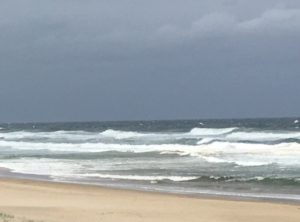
The Coral Sea is one hundred metres down the street. Yesterday we were swimming in the warm sheltered waters of Tea Tree Bay in Noosa.  This morning though, the sky is grey and the sea is furrowed with fierce foaming waves that pound onto the powdery sand beach – a sand so fine that it squeaks when you walk on it. I see the solitary billowing neon orange sail of a kite surfer who is experienced enough to enjoy these conditions.

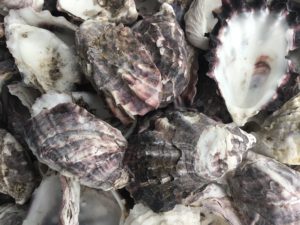
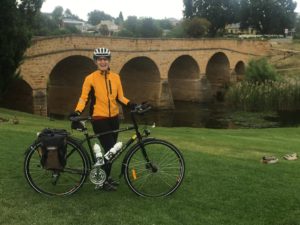
I have been travelling in Australia, most recently bike riding in Tasmania where the Dunalley oysters are the best I have ever tasted – briny firm-fleshed with a sweet finish.

I’m in a land where I have to remind myself what marsupial and monotreme mean. I’m visiting a continent where the animals have great Scrabble word names such as echidna, galah, goanna, quokka and quoll. I’m in a place where Qantas does not have a U. Qantas, the national airline name is an acronym for Queensland and New Territory Air Service. None the less, once you reach Australia, the internal flights of Qantas, Virgin or Jetstar are cheap and plentiful. Australia is like Canada with the population flung around the edges of a vast otherwise nearly empty land.

There is currently no writing routine other than intermittent journaling in the battered lavender book that gets stuffed into one of my bike panniers each morning. My reading is a sporadic listening to Australian Edwina Wren present the audio version of Geraldine Brooks’ The People of the Book, a historical fiction based on the Sarajevo Haggadah. It is a who-done-it with interesting information about the production and preservation of Medieval religious tomes woven around the plot.

On the flight here, I finished Joe Moran’s First You Write a Sentence. I recommend his book to anyone who reads or writes and I am looking everywhere for a chance to use more verbal adjectives and adverbs. Oh yes, vary sentence length.

Petrarch’s in Launceston, Tasmania is a delightful independent bookstore with a good collection of books by Tasmanian authors. I bought two children’s books, written and illustrated by Jennifer Cossins, 101 Collective Nouns and A – Z of Endangered Animals. I stumbled upon a beautiful pocket-sized edition of the Collected Poems of WB Yeats – a nice place to hide in as I wait for flights that are delayed or cancelled due to the recent weather extremes.

I desperately wanted to buy Anna Burns’ Booker Prize-winning novel Milkman but it won’t fit in my luggage allowance – maybe for the journey back to Canada. And also David Malouf has a new collection of poems, An Open Book – perhaps that would be the best souvenir of this trip to Australia.

Filed Under: Uncategorized

A Month in the Desert

October 18, 2018 by Carolyne Montgomery

Thanks to all of you who have signed on for updates to the blog. It has been an interesting few weeks down here in the Coachella Valley.  My life at least until a few days ago when I sprained my ankle playing tennis, involves early starts on the patio that we are sharing with at least three species of Hummingbird including my new favourite, the Costa with its jaunty purple and white head markings. I have been enjoying the golden alpenglow of the desert sunrises and sunsets.

After coffee, while the temperatures are still cooler, we head out for a bike rides or to play tennis. It is a split-shift sort of life that reminds me of my waitressing days and requires a mid-day retreat from outdoor activities between noon and four as the day heats up to the low thirties. This allows for some reading and writing.

I have seen the destruction resulting from a rare but severe thunderstorm. Our bike route up Thousand Palms Canyon road was covered with sandy mud and the road had to be ploughed to remove it. The Coachella Valley Preserve was closed as the hikes were washed out. We hiked along the ridge of the Pushwalla Palms trail where we could see the trail of the palm oases that follow the San Andreas Fault. The desert is like the ocean where you can simultaneously die of thirst and drowning.

Meanwhile, I was listening to the audio version of Women Talking by Miriam Toews read by Mathew Edison. The male narrator August, a returned exile of the community, has been chosen by the group of eight Mennonite women to record their secret meetings. They are trying to decide what is the best action for the women of their colony after several male members who have drugged and raped hundreds of the women are being returned to the community. The women are being asked by the colony leader to forgive the men and resume their obedience and subordinate service roles in their community. They discuss their choices of leave, do nothing or stay and fight. They debate which of these actions is closest to their faith and practical as none of the women are literate or have ever had any contact with the outside world. The women realize that if they stay to negotiate changes with the men, it will be the first time they have ever asked the men to do anything.

At the same time, I was writing a piece on the importance of listening in therapeutic situations. I was thinking about women, regardless of race, appearance or class being able to speak without interruption, to be heard and understood, not only by men but other women.

And of course, I was following the testimonies of Christine Blasey Ford and Brett Kavanaugh at the American Senate Judiciary Committee. I saw the dignity, and professionalism of Ms Ford’s testimony contrasted against the rambling emotional incontinence of the US Supreme Court nominee. I suffered with her as she was discounted, disbelieved and humiliated.

There is a part in Women Talking where the women discuss the concept of the men as being victims as much as the women who have been raped. One of the women proposes that forgiveness is in order as the rapists men are victims too because of their socialization into specific gender roles by their Mennonite society. The women worry about the future of their adolescent sons if they leave them in this community of men.

This leads to the question of what is a core set of socially responsible common values for society and an article on the simplicity and emotional appeal of tribalism from George Packer in the New Yorker who describes the work of the More In Common group. It would be interesting to see what groupings would result from a Canadian study.

And despite its decriminalization legalization in Canada this week, I’m not touching any marijuana issues for health purposes or otherwise.

Filed Under: Uncategorized

The Magic Mountain

October 4, 2018 by Carolyne Montgomery

On my own mountain tour to Mount Hood and Crater Lake in Oregon late this August, I lugged about a door-stopper, hardcover edition of The Magic Mountain, translated by John E Woods from the original German. It was written by Mann when he was in his fifties around the time of WWI.

After reviewing the erudite introduction by AS Byatt and being admonished that “hurry makes it seem intolerably slow and overloaded”, I proceeded to skim through the book. I slowed down at times to enjoy the elegant descriptions from the omniscient narrator and to worry about whether I was properly appreciating or understanding some of the allegorical narratives.

As a person with medical training, I found the details of the treatment of tuberculosis in the pre-antibiotic era by rest cures in high altitude sanatoriums interesting. The residents must submit to the passage of time at altitude and occasional radical lung surgeries for any hope of survival. Similar to an eldercare institution of today, they are surrounded by the dying and the possibility of the futility of the treatment.

As I sat in a chaise-lounge at 6000 feet overlooking Crater Lake, I wondered if I would have ever mastered the correct way of folding the blankets over myself in preparation for the afternoon rest cure. Mann proposes in the character Castorp, the phenomenon of illness as a refuge from the challenges and disappointments of real life. Castop’s cousin is a victim of his patriotism and the eventual recrudescence of his disease. The other characters in the sanatorium are instructive caricatures engaging for example in romantic difficulties or philosophical struggles over humanism versus religious faith. The narrator gently mocks their characteristics.

And so I hurtled to the end of the novel with little empathy for the protagonist Castorp but many moments of astonishment and bemusement at the use of language and the skill of the translator.

Filed Under: Uncategorized

Celebrating Mary Pratt

August 22, 2018 by Carolyne Montgomery

I was sorry to hear of Mary Pratt’s passing this week. In fact, when I was in Ottawa this May I made a special visit to the National Art Gallery to try to see her painting, Red Currant Jelly. I love its vivid celebration of the domestic task of preserving fruit. Sadly, the piece was not on display and I had to console myself with a Gathie Falk work instead. I wrote this small piece a few years ago. It is an imaginary interview with Mary Pratt in her kitchen on the day that she is making the jelly in her painting.


Red Currant Jelly

Where was that fourth matching glass on that day when Mary Pratt took the Kodachrome slide for her painting Red Currant Jelly? Had it smashed onto the cold tile floor, the result of some careless or intentional hand? Did the sweeping up of the scattered and grating little Pyrex pieces disappoint her? Did she welcome the asymmetry of the substituted sherbet glass?

She is thirty-three and halfway through her marriage to Christopher. Were they already hissing at each other in the hallways, resentful of each other’s talent and time?

“Mind you,” she cautions, “When you clean the berries, you have to leave the stalks. That’s where all the pectin is. It was my mother’s trick. I use an old pillowcase that I hang up overnight over this bowl.”

She smiles and tips the empty brown stoneware bowl towards me. The creamy cracked glaze interior reveals the long service in this kitchen.

“The juice collects in here overnight. In the morning, I heat it up with a pound of sugar for each pint of juice and then pour it into these glasses. I can see you are wondering about the tinfoil?”

I am still wondering about the missing glass. I see her with frizzing hair, steamed up glasses and burnt, sticky fingers, methodically stirring the boiling pan of jelly. The jelly droppings from the repeated testing are forming a red mess on the small white plate. The kitchen is filled with the syrupy scent of the berries.

“Of course, you know that red is not just a colour.” she says softly, “It’s an emotion.’’

She smiles back at me over her shoulder while continuing to empty the dish rack on the counter of the breakfast dishes.

“And the tinfoil?” I ventured.

“I put the tinfoil on the counter to protect it from stains. The red juice will never come out. You can easily get the fruit stain out of fabric you know but not from the counter. Take this apron for instance.”

She holds up the white apron she wore when she was mashing the currants. The bib is splattered with a constellation of red stains. She fills the kettle and puts it on the gas hob. After several minutes, it whistles imperiously.

“There. Boiling water. I stretch the stained area over this bowl and pour the boiling water through the stain.”

Alchemy. The red stain has vanished into what is now steaming pink water.

“But what about the whole painting?” It felt like it was a good time to ask.

“Well.” she paused. “It’s all about the light. There is a small truth in each point of light. I assemble them into the jelly, the glasses, the plate and the tinfoil. I try to paint the truth.”


Filed Under: Uncategorized

  • « Go to Previous Page
  • Page 1
  • Interim pages omitted …
  • Page 4
  • Page 5
  • Page 6

Primary Sidebar

Recent Posts

  • Spring Is Sprung …
  • Chapter 4: The Tree
  • Reflecting on Aging and Kathy Page’s Memoir
  • Chapter 3: Alterations
  • Chapter 2: Webbed Feet

Archives

  • April 2026
  • March 2026
  • February 2026
  • January 2026
  • November 2025
  • September 2025
  • May 2025
  • December 2024
  • October 2024
  • July 2024
  • June 2024
  • May 2024
  • November 2023
  • October 2023
  • August 2023
  • November 2022
  • May 2022
  • March 2022
  • December 2021
  • October 2021
  • June 2021
  • April 2021
  • February 2021
  • December 2020
  • October 2020
  • July 2020
  • May 2020
  • March 2020
  • February 2020
  • January 2020
  • November 2019
  • October 2019
  • September 2019
  • July 2019
  • June 2019
  • May 2019
  • March 2019
  • January 2019
  • December 2018
  • October 2018
  • August 2018

Pages

  • A Swim in a Pond in the Rain – A Commentary
  • About Carolyne Jane Montgomery
  • Contact
  • Home
  • Independent Bookstores
  • Privacy Policy
  • Publications, Readings and Other Stuff
    • The Solstice Party
  • Signup

Copyright © 2026 · Carolyne Montgomery · All Rights Reserved | Support by Mastermynde