Trigger warning: Rape scene and eating disorder
After Stéphanie is raped, she develops anorexia. Claire kicks Michael out for having an affair with a graduate student, Lucie. Nan provides the healing love that Stéphanie craves.
The Hummingbird
It’s the middle of September. I’ve been locked up here on the Eating Disorders Unit of the hospital for three weeks. There are nineteen sad-looking girls with ugly plastic ID bracelets on their wrists walking out around this long ward with the alarmed doors at each end.
I did some stupid stuff this summer, like starving myself. But the best stupid thing I did was getting a tattoo. A black outline of a hummingbird sits on my right shoulder. Nan, my grandmother, took me to the parlour around the corner from her place in Verdun and signed for me. It didn’t hurt that much. No one else knows, not Mom, not Dad and not my older sister, Brianna, who is sixteen. I love it and I’ll have it forever. I got it in May, the week that Mom threw Dad out. He was screwing one of his graduate students. Now he’s in Victoria, teaching at the university and I’m locked up here.
You can tell who’s new here on the ward. Until the staff trust you, you wear pink scrubs with the hospital initials, HSJ, printed on them in sulking black letters. The twill polyester fabric grips the thighs of the fat girls and sags from the shoulders of the skinny ones. Everyone here is too something—too fat, too skinny, too needy, too boring, too sad, too hopeless. The fat girls hate the skinny girls, and the skinny girls hate them back. I can smell it. The one thing we all agree on is don’t trust the workers. Any second, somebody might grab you and force a piece of bread or a pill down your throat.
I’m not even the skinniest girl here. The week I arrived Genevieve was transferred to the ICU. Emélie stayed out of ICU by allowing them to insert the slender yellow feeding tube that dangles from her nostril during the day and feeds her at night while she sleeps. A stale milk odour lingers ‘round her.
I told the nurses I smoke so I can chew Nicorette like a few of the other girls do. It tastes terrible but I get a bit of a buzz and something to do besides folding origami cranes and journaling. This journaling is killing me.
I love to read and write but here, I’m supposed to write down the good things about my mom—determined, smart, industrious, and so on. If I think of a bad thing, I change it to a good thing—bossy to organized, away-all-the-time to committed-to-her-work. Like that. The therapists help me find good ways to think about her. I’ve scribbled a lot in this book and today I wrote kind and loving because that’s what I want to be. I mean I’m making this stuff up anyway.
And the whole time I’m doing all these exercises, I’m thinking about what I did in June. And every time someone asks, “Is there anything else you’d like to tell me?” I shake my head and say “I don’t think so.” But here’s what happened.
It was the first week of June. I was walking to school past the grand houses in Westmount with their green velvet lawns, tidy flower beds filled with early blooming roses and the scents of lilac and wisteria. But it was a sad time for me because Dad had left for Victoria the May long weekend. And that week, Brianna, who was nearly sixteen and in Grade Ten, ditched me to walk with her friends. All they talk about is the movie that Mom won’t let me see, The Hunger Games.
A wolf-whistle startled me. Who whistles like that? I jerked my head around. A gardening guy in a green T-shirt and cut-offs standing beside the rose bed, grinned at me from under a darker green ball cap. The green leafy curling La Scène Verte logo on his hat matched the one on his t-shirt. His lips were pouty and his smile lopsided to his right. His tanned calves bulged above his work boots.
He raised his arm and waved. Flustered, my thumbs stuck beneath the shoulder straps of my backpack, I flickered my fingers in his direction. My heart was whirring. My face was burning. He was staring at me, my legs. I tugged my uniform skirt down to cover my legs and shoved my thumbs further under my backpack straps. I wanted to run but that would look too lame. And right away, I knew I wouldn’t tell anyone what had happened, especially not Brianna.
For the next two weeks, I walked the long way to school, past the apartments. It wasn’t as pretty but I didn’t have to think about running into that guy again. But that wasn’t true. I was thinking about him a lot and why he did that. Did he think I was cute? The guy was maybe twenty.
Had Dad ever whistled at girls like that when he was that age? My stomach clenched as I imagined that grad student with him in Victoria.
I’d been rolling up the waistband of my uniform skirt after I left the house each morning. I stopped. I wanted it to cover my knees. The other girls would have teased me if I didn’t hiked it up when I was at the school gates. I had the longest skirt of all of them.
It was the day of my English final. I was late and took my old route. When I turned the corner, I saw a truck with La Scène Verte painted in large, pale green letters on its side parked in front of the same house. What would I’d do if that guy was there. I walked faster and pulled Dad’s tattered Expos hat down over my brow.
“Hey you,” a low voice called out.
I kept my head down. “Got an exam. Gotta go.” He walked toward me but stayed on the grass. I backed away to the far edge of the sidewalk.
“Meet me after? Coffee?”
He seemed nice with his crooked smile. My heart was racing like the last time. The oldest boy I’d ever spoken to was in Grade Ten and now here was this guy, all muscly and big-jawed, trying to get my attention. “I have to go.” I turned and ran the five blocks to school without stopping. At the iron railings, I bent over, sucking in deep breaths, and waited for the pounding of my heart to stop. I didn’t notice the pain from my shoulder strap rubbing on the skin of my tattoo until I was sitting in my exam.
I knew Lord of the Flies, inside-out so even tho’ my brain was fizzing with confusing thoughts—he was interested in me, a skinny Grade Eight kid—the exam went OK. I was chatting with my girlfriends by the school yard railings when I saw him. He’d followed me. He waved that same wave and smiled that same smile.
“Do ya’ know that guy?” my friend Becky asked as we gathered by the railing.
“Not exactly.”
“Why’s he waving at you?”
Becky wrapped her arms around her chest so her hands clutched her back like she was being hugged by a guy. “Stéphie’s got a boyfriend,” she chanted.
“Do not. Don’t even know him.” Idiots, I thought as I spun about and stomped off toward the school gate. But he tracked me from the other side of the railings.
“Hi. Wanna go for coffee?”
That husky voice. My stomach fluttered. “I don’t drink coffee.” My voice was squeaky, and I knew I must be blushing again.
But that was how we got started. He bought me a Coke from the dépanneur and we shared it on the bench in the park near the school. He held my sweaty hand. His fingernails were dirty, his palms rough. My hand felt fragile inside his grip. He put his arm around me. I smelt the salty sweaty scent from his day’s work. He was way taller than me and meaty against my boniness.
We met every afternoon for the rest of the week. He told me his name was Roy. I think I told him mine, but he only called me Babe. I never learned his last name or where he lived or anything important about him.
He held my hand and touched my lips with his fingers. He said he loved my long thick hair and ran his hands through it. He touched my neck and held my face in his hands. We hadn’t kissed yet, but I’d decided that he could be my boyfriend. Brianna had a boyfriend so why shouldn’t I? I wasn’t going to tell her yet. I imagined us hugging and kissing on the couch in the basement like Brianna and Marc did. Maybe even French kissing?
The morning after my last exam, he picked me up in his friend’s rusted-out Honda Civic. We’d planned to drive to his friend’s cottage in the country for a swim in the lake. It was a steamy June day. For sure there’d be a thundershower later.
“Come on. Get in.”
I climbed in and untangled the seatbelt. The car stank of tobacco and maybe even dope. “Where are we going exactly?”
“My buddy’s cottage. Lac-Brome.
I didn’t think he knew people rich enough to have a cottage, but I was curious.
“Got your suit?”
“Sure, I do.” I fished out my bikini top from the plastic carrier bag and dangled it in front of him. He laughed. I put my bare feet up on the dashboard. Last night, Brianna painted my toenails Barney purple. They looked pretty cool. I wore my cut-offs and my favourite stretchy orange tube top. I checked my watch. It was ten-thirty. As long as I was back by five, Mom, who had already left for work, wouldn’t even know I’d been out.
It was hard for me to hear what he was talking about because of the screeching of his heavy metal CD. Somebody leaving some band to join another or overdosing or something. He said such dumb things, it was easier to like him when he didn’t speak. He kept one hand on the steering wheel and reached over and touched my left thigh with his fingers. I wanted him to take those rough fingers away but I did nothing.
“Nice thigh babe.”
I didn’t have a cellphone. Brianna would’ve asked too many questions that morning if I’d tried to borrow hers. Dad had gotten her one in May just before he left. It wasn’t even her birthday. I wished I’d pushed Dad harder to get me one too.
“You just turned fourteen. What do you need a phone for?” Dad said as he gave Brianna the box.
“You know, emergencies,” I’d said.
“How about not having any emergencies,” he’d said, patting the top of my head.
I should have kicked up more of a fuss before he’d gone off to Victoria. I could have said that if I had a cell phone it would be more convenient for Mom while he was away. And now Dad was gone, there was no point in asking Mom for one. And even if I’d had a phone, would I have done anything different?
We turned off the autoroute and drove past farms and white clapboard churches with metal roofs. I’d been out here before on a Grade Six school trip to a cabane à sucre. It had been early spring then. Snow was on the ground and the maple sap was running. Only three years ago, but what a goofy little kid I’d been then—a sucky little Daddy’s girl.
Roy stopped at the Boni-Soir in Bromont. I waited in the car, smoothing the place on my thigh where his hand had been. He strode out carrying a brick of cheese, some pepperoni sticks and two big bottles of beer. I wasn’t hungry and I didn’t drink beer. Dad liked to tell the story of when I was three and had tasted his beer. I’d scrunched up my face but had insisted on another sip.
“Where are we going again?”
“Lac-Brome. Soon. Change that CD, eh?”
I peeled my back off the plastic upholstery and slipped in a different disc—more whining guitar solos and pounding bass. I like the music that that Mom and Brianna like—Arcade Fire, Great Lake Swimmers, Cowboy Junkies.
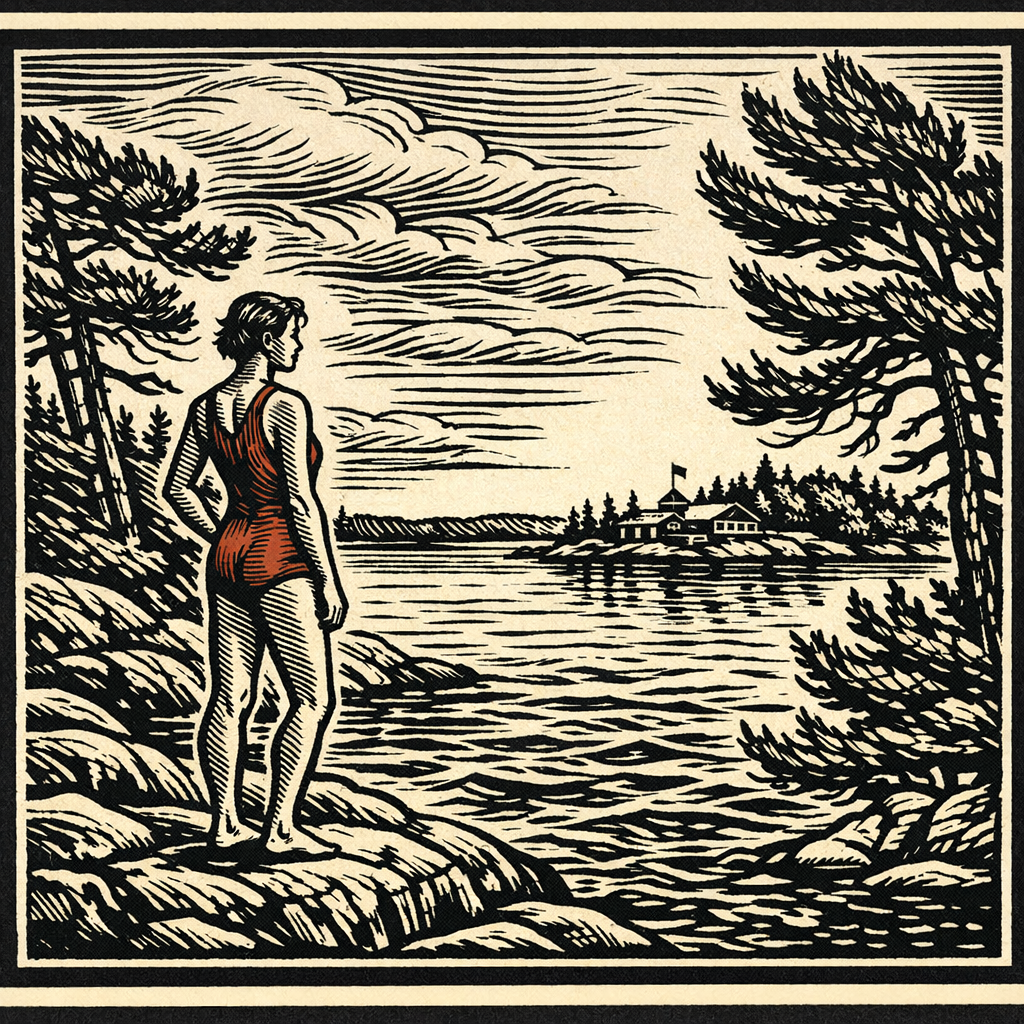
After a few miles of rattling along the washboard gravel road, he pulled into a dirt driveway. A white trailer perched on blocks overlooked the lake. Somebody was into gardening and had planted geraniums and marigolds in the two small beds in front of the steps. The lake was still, maybe resting before the weekend invasion of jet skis and wakeboarders.
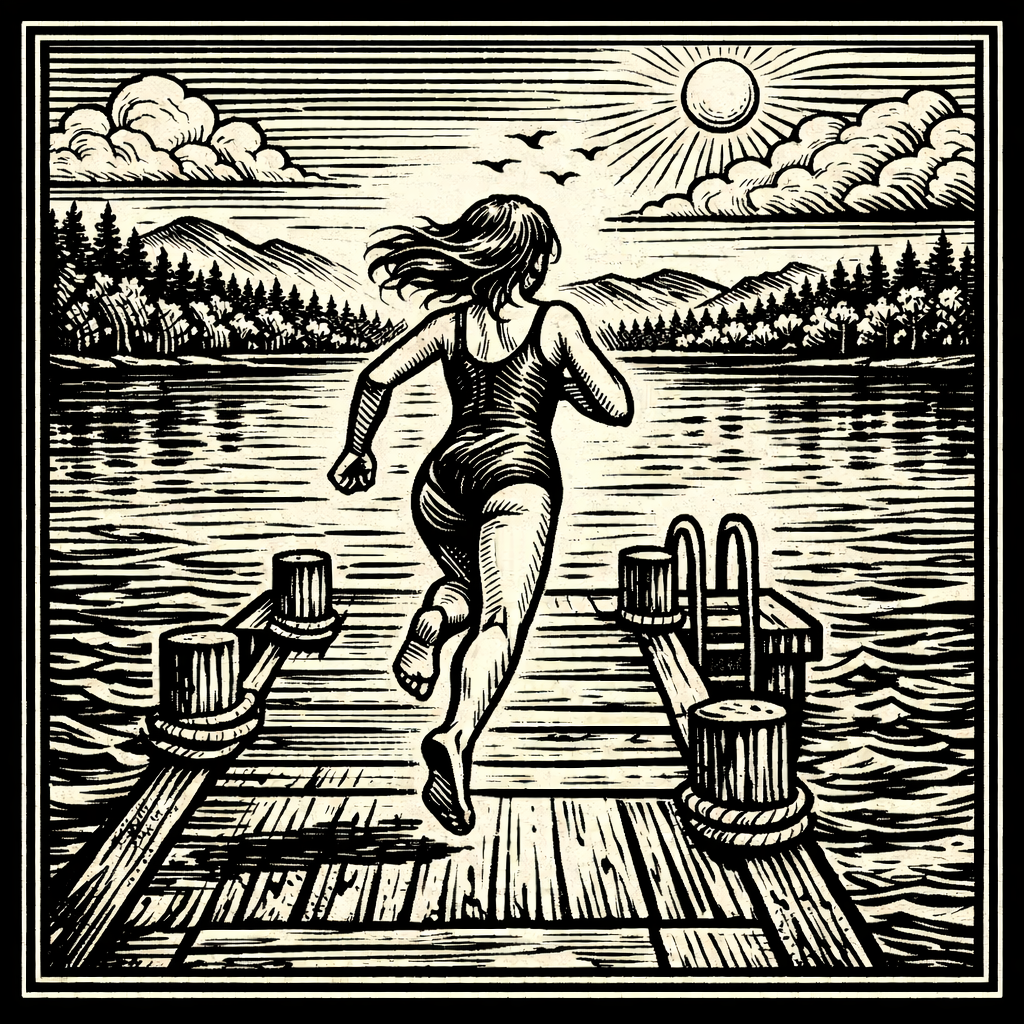
“Let’s go!” He pulled off his green T-shirt. Did he only have one? And his cut-offs. No undershorts, just his muscled white ass charging down the dock. He cannonballed off the dock and into the water with a messy splash.
“Come on Babe. Jump in.”
I’d skinny-dipped a thousand times before with Brianna and the other kids at our cottage, but this felt more dangerous. I pulled off my top and wiggled out of my jeans but kept my underpants on. I wasn’t that crazy. I hardly knew this guy. Would he notice that my right nipple was a bit larger than my left one or that I didn’t shave my legs yet. I grabbed my towel and ran down the dock, clutching it to my chest.
Later, inside the trailer, he stood naked in the kitchen. His feet were white and pale against the cracked brown linoleum floor. I’d made a mini-dress with my towel. He gnawed at the pepperoni stick and slugged back a beer. “Want some Babe?” He pressed me against the metal edge of the kitchen counter with his hips.
“Not hungry.” I pushed the strings of wet hair off my face and wished that I’d brought a scrunchy. I looked past him at the yellowed square plastic wall clock. It was 12:30. The red second hand jerked clumsily past the black minute markings.
He leant over me. “I want you.” His lips were greasy, and his breath stank of beer. I felt sick. He grabbed my hair and tipped me further back against the counter. He pushed his tongue into my mouth. He put his arm around my waist, steered me into the living room and pressed me onto the couch. The fabric was scratchy and sticky. He flopped onto me like a panting dog. He was heavier than I’d imagined. “I want you,” he said huskily as he tugged at the towel ends tied above my chest.
I wasn’t sure what to do but I was certain that Brianna had already done it with Marc. So why shouldn’t I? It’d be like a science experiment. I swallowed the acid taste in my mouth.
“Touch me, Babe.” He took my hand and folded my fingers around his erect penis. It felt dry and rubbery in my hand. He pulled my hand up and down. I didn’t want to look.
“Harder.”
It felt silly but he was gasping and groaning like it was something. I didn’t want to disappoint him or upset him. I had to stay curious.
“Babe, I need to fuck you.”
I nodded and squeezed my eyes shut as he pushed himself inside me. It hurt.
He whimpered and finished with a shudder. And then I knew what all the fuss was about. For guys anyway. But what I hadn’t expected was that after he had that nap, he’d want to do it all again. And the whole thing took longer this time and I was sore. Was what it had been like for Brianna with Marc?
Afterwards, I squirmed out from underneath his limp body, grabbed my towel and tore down the dock. I splashed into the lake. The cool water rushed against my battered parts and rinsed away the stickiness from between my legs.
When I got home, I went to Mom’s mending basket and found Nan’s second-best, brass shears. I locked myself in the upstairs bathroom. I shook as the thick chunks of hair fell onto the floor. The rasping of the sturdy scissors calmed me. I thought of the fragile crepes and organzas that Nan had cut with these scissors. I stood in the middle of the tangled mess on the floor and cut and cut and cut until my fingers were hard against my scalp and the scissors were hard against my fingers.
When Brianna saw me, she brushed her fingers through the remaining tufts on my head and said, “I know you’re sad. We’re all sad. It’s hard with Dad gone.”
And I hugged her and cried but I didn’t tell.
The next day, when we went to the salon, the stylist squeezed some minty lotion onto my scalp and promised when I came back in September, I’d get the best cut.
Nan, who was looking after us while Mom was away in Costa Rica with her bird people, said nothing. She made chicken for dinner. That was when I stopped eating.
Mom went away again to Costa Rica in August with her bird people and Dad stayed out in Victoria. Brianna had her lifeguarding job and her cell phone. They were all too busy that summer to notice I was melting away under the baggy T-shirt I wore all the time.
I concentrated on getting down to one hundred pounds. I liked the tidiness of the one and the two empty zeroes. I believed I’d feel better at one hundred. It felt so good not eating. I felt so powerful and I loved it. I was the skinniest one. And then my gums started bleeding when I wasn’t even brushing my teeth.
It was the morning of the first day back to school after the Labour Day weekend. I reached up into the kitchen cupboard for a drinking glass and my uniform skirt slid off my hips. I grabbed the waistband and hauled it up but by then Mom had seen.
“Why are you wearing Brianna’s skirt?” she snapped.
“It’s mine, Mom.” I don’t know why I didn’t lie.
“Oh my God. Look at you. You’ve stopped eating.” Her voice softened and she touched my shoulder in the tenderest way I’d ever felt. She was crying. “Oh Stéphanie, how is this family going to find time for this?”
And I felt bad for her that I was causing trouble. I dropped my gaze and asked, “Are we still a family, Mom?”
So that’s my story. That’s how I ended up here. And what do I think now about what I did these three months later? What I feel is mostly stupid. Careless.
“Is there anything else you’d like to tell me?” they still ask me.
And why would I let some stranger barge in on my shame? No. It’s private. It’s mine. It’s my regret.
He never used my name. I can’t even say for sure whether I told him what it was. I was Babe. A toy. Roy was a boy and I was his toy. And I still can’t name what I felt—scared, curious, excited or disgusted. All of those things? All at once? But mainly ashamed—ashamed I’d feel better than Brianna.
It’s the last week of October. Dad has flown in from Victoria to see me. I haven’t seen him since the May long weekend. Ha! Victoria Day weekend, the weekend he went to Victoria. He’s at his old teaching job at U. Vic. where Mom and he lived before they moved to Montreal. He’s in the Environmental Studies department— more bird stuff, a climate change researcher.
Mom told us her side of the story in May when he left. “Your father made a terrible choice that has devalued our relationship. I’ve asked him to leave.”
“Will he come back?” I asked.
“That depends on him.”
And tho’ Mom sounded harsh, I could tell from her cracking voice that she was about to cry.
That graduate student Lucie, the one with the thick brown hair, who hung around him all winter, was the one. She’d even come up to the cottage in St Sauveur last February for a weekend of snowshoeing. Each time I was at the lake that summer, I’d find those long, wiry hairs in the shower, on the bathroom floor and behind the toilet.
There’s a private room on the ward where patients can meet approved visitors. Mom isn’t one. The doctors decided that Mom shouldn’t visit for the first few weeks. I don’t miss her, but I worry about how she’s doing without Dad. Probably working too hard.
The room has a barred window, covered with a set of battered, yellowed blinds and overlooking the parking lot. There are two gaudy re-covered couches that despite all reds, yellows and oranges are still saggy and uncomfortable. Dad looks tired; he’s lost weight too.
“Thanks for coming Dad.”
“I’d have come sooner but it would have upset your mother. We’re both worried about you.”
“I felt so powerful not eating. I loved it.”
“You sound like a drug addict.”
“It’s the same thing, Daddy. I think about food all the time.” My voice is squeeky. I might cry.
“I need to say I’m sorry for…” he started.
“Stop it. I don’t want to hear about it.”
He wraps his arms around me and squeezes me until I can barely breathe. “I’m not supposed to mention your weight, but this is like hugging a skeleton,” he said.
“I’m fixing it Dad. I’ll get better, I promise.”
It’s after Halloween when Brianna brings me the chocolate. She puts the wafer-thin bar down on the scratched Formica surface of the coffee table in the lounge—Swiss, dark with sea salt. Each of the ten squares has exactly fifty-four calories. The delicate foil makes a crinkling sound as Brianna unwraps it. She tries to snap the bar along the lines, but it breaks into ten uneven pieces. I study the foil surface covered with the dark chocolate puzzle pieces.
“Would you like a taste?” Brianna asks.
I do. I imagine the chocolate melting inside my mouth, the taste of the bitter cacao and the velvety texture coating my tongue. My rules about food seem too harsh, too nasty and too tiring. But if I do take a piece, what could I avoid eating later without upsetting the nurses?
“You don’t have to.”
“But I want to.” My hand shakes as I reach for the smallest fragment, the size of my baby fingernail. I hold it between my thumb and forefinger close to my face and inhale the chocolatey smell. My mouth moistens. I place the piece of chocolate on my tongue and close my lips. It feels dangerous and sacred like the time I took Holy Communion at Nan’s church when I wasn’t even confirmed.
Brianna sighs and I know from the way she is scrunching up her face that she might cry. The chocolate melts on my tongue. There is a zing as the sweetness enters my body. “I need a drink of water, Bree.”
She rushes away to get the plastic cup of water from my bedside table. When she gets back, I gulp down the whole thing.
“Do you want another piece?”
“Not at the moment. I need to think about it.”
I start to get better like I’d promised Dad I would. Maybe I would have gotten better anyway with all that counselling and those anti-depressants. I finish all the yogurt in the container. I eat all the tuna in the sandwich. My muscles get stronger. The boney ridge on my shoulder blade where my hummingbird lives softens. I want to take care of that hummingbird. I want to go back to school. I want to see my friends. I want to grow up and have a real boyfriend. I want someone who’ll love me.
It’s the end of November. The doctors say it’s safe for me to go home but I don’t want to go home. It’s not home with Dad away in Victoria. They let me go to Nan’s. She’s always kind to me.
I slouch on Nan’s tiny couch in my pajamas watching Saving Hope, Jeopardy, and Disney princess videos. Brianna and I know all the words to every song in the Little Mermaid. It’s our favourite. Nan explains what she is doing as she sets a sleeve in a blazer, tacks interfacing on a collar or covers buttons. She turns flat bolts of fabric into jackets and dresses and coats like a good sorceress with a magic wand. Sometimes Nan lets me do the basting or if the fabric is not too fine the hemming. Nan doesn’t barge about grabbing misplaced things or talk about how she is late or tired all the time. She doesn’t interrupt me when I’m reading or drawing.
We eat properly at the kitchen table. And unlike Mom, Nan likes to cook. Lunch today was real chicken noodle soup. Tonight, at bedtime, we’re having hot chocolate. And if there are any left, ‘cos we’ve been snacking, a chocolate-covered digestive biscuit. Tomorrow, I’m learning to make an omelette.
In the therapy sessions they explained that my problem is wanting to be perfect. But that’s not it. They’re mixing me up with those other girls—the dancers, the gymnasts, and that cellist. It’s Mom who wants me to be perfect—top marks, tidy room, swim team, which I hate. I drop whatever I’m doing to help her find her keys or papers so that she can get her precious stuff done—saving migrating birds and the planet. And they never explained to me why Brianna didn’t get sick? We have the same mother.
Brianna visits me at Nan’s most days after school and brings me homework. My pills help me concentrate. I might catch up on one course, maybe English. Will I ever tell her about Lac-Brome? Not yet, for sure.
“Mom misses you, Stéphanie,” says Brianna this afternoon.
“I miss her sometimes too.” And it’s true. Mom is so energetic and knows so much about migration and light pollution and climate change and how to run a meeting and circulate petitions. She travels to Central America for weeks with only a carry-on.
“She wants to visit, maybe this weekend for Sunday lunch?”
The whirring of Nan’s Singer stops. I tug at my new haircut.
It’s Sunday lunch. I helped Nan by chopping the carrots and potatoes for the pot pie. She made the pastry. Mom looks tired. She kicks off her runners and throws her jacket on the couch. She’d go crazy if I did that at home. She scans all the sewing stuff crammed into the parlour. “Well, this is cozy.”
Nan glares at her.
“If you’re serious about this vegetarian thing, Stéphanie, this pastry better not have any lard in it.”
“It’s Crisco, Claire,” Nan says.
“I won’t be having any. You know, the calories. Work’s been crazy. Finishing my book.”
Mom always says that. She always says work’s crazy. and she is too tired. Nothing’s changed.
“I hope you’re pulling your weight around here Stéphanie.”
I winced.
“Well, I know how easy it is for you to sit back. But running a house doesn’t happen by magic.”
“Stéph’s a great help to me, Claire,” Nan says.
Brianna interrupted. “It’ll be great when Stéph’s ready to come home.”
I’ll never get used to calling the house “home” if Dad isn’t there.
“Why don’t we try a weekend together at the cottage? Go snowshoeing,” says Brianna.
“I’m not up for that,” says Nan. “Too cold. With Christmas and New Year’s coming, I’ve got three gowns to finish here, all velvet, taffeta and silk. Nightmares to handle. You three go.”
And I imagine the cottage, the roof blanketed in pillowy snow, the glistening frozen lake and the creaking under my snowshoes as I pack down a path to the porch steps. But I can’t imagine being there without Dad.
The car crunches to a stop at the edge of the snowplowed gravel road. The outline of the empty driveway is filled with fresh snow. Brianna and I bundle up in our down jackets. I’m wearing three other layers. We put on our mitts and hats and hatch out of the car into the cold. The snow squeaks under my boots. It’s the first time I’ve come to the cottage since the Labour Day weekend.
The silhouettes of the naked maple trees darken in the twilight. A full moon is rising over the rounded peaks of those worn-out Laurentian mountains; the receding glaciers having ground them down. I miss Dad’s ritual explanation of the whole glaciation thing.
“Shush. It’s an owl.”
I turn in the direction that Mom is pointing and hear a throaty hollow questioning. “Whoo, Whoo, Whoo,” repeating through the woods.
“It sounds so lonely and sad,” I say.
“Shush up. Listen,” she says.
I stand still and watch the moonlight strengthening the skinny dark shadows of the bare trees on the pale snow. My fingers tingle and my feet are freezing.
“Sounds like a Great Grey Owl. So rare.” Mom puts on her snowshoes, turns off her headlight and tramps away in the direction of the hooting.
“Bye Mom,” I whisper in her direction.
Brianna and I Bungie-chord the two snap-top containers of supplies to the toboggan and strap on our snowshoes. We take turns stamping out the trail or dragging the toboggan across the powdery snow. Although I’m stronger than I was a month ago, I’m breathless with each step. Brianna does all the work.
Brianna lights the fire in the wood stove with the first match and we stare at the flickering flames. Last fall, Dad and I split maple pieces and stacked wooden kindling. “Weird to be here without Dad,” I say.
“We’ll be OK. He taught us how to do everything we need to,” says Brianna.
I cuddle up against her warm, solid body and re-arrange the blankets on the couch. We watch our breath evaporate into the room. Soon it will be hot enough to take off our coats and mittens. I adjust the toque on my head. It’s staying on no matter what. Nan’s vegetarian chilli warms on the top of the stove and smells good.
“What’s it like at home, Brianna?”
“Trying to keep Mom happy. She’s pretty mad.”
“Except she can’t figure out that she’s mad. She thinks she’s just busy.”
“I’d like it if you came home. It’s easier when there’s two of us.”
I could stop being so mad too. I’m so tired of being angry and sad.
The next evening Brianna and I sit on the couch in T-shirts in the roasting cabin. Mom is out tracking the poor owl. “Who? Who?” it calls wondering who is tracking it. Or maybe it is “Whew! Whew!” because Mom hasn’t found it.
“Disgusting to think of Dad and Lucie doing it, right here on this couch,” Brianna says.
“Any moment, we’re gonna find another one of her hairs. Think she’s with him in Victoria?”
“Maybe. Or maybe it didn’t work out. That happens.”
“Will Mom forgive him?” I ask.
“Nope.”
We rearrange ourselves among the pillows and blankets on the couch.
“I’ve got a secret. I’ve been meaning to tell you all month,” Brianna says as she smooths my toque and takes my face in her warm hands.
“Go.”
“Marc and I finally did it.”
“And…” I try to look pleased but turn away. I feel sick.
“It was OK. I think it’ll get better.”
“Were you safe?” After being locked up with all those other girls, I know enough to ask that question now.
“We figured it out.”
I was wrong about her and Marc, having already done it. I was wrong to have gone a guy I didn’t know. Such a stupid, stupid, stupid thing. “I have a secret too.” I say. I turn towards her, pull the neck of my T-shirt off my shoulder and show her my hummingbird.
“When? How?”
“With Nan. In May. I was so sad when Dad left. She wanted to help.”
“It’s beautiful and it’ll be there forever,” Brianna says as she traces her finger along the curving outline.
“Yes, it will,” I say, straightening up my shirt. “It will be there forever.” Along with everything else I did. And one day I’ll be able to trust Brianna enough to share my secret.
The End