This piece started out as a meditation the verbs, parenting and adulting, both examples of when a word that is historically used as a noun (eg: parent or adult) is transformed into a working word, a doing word, a verb, to parent – the activity of bringing up a child as a parent.
For the
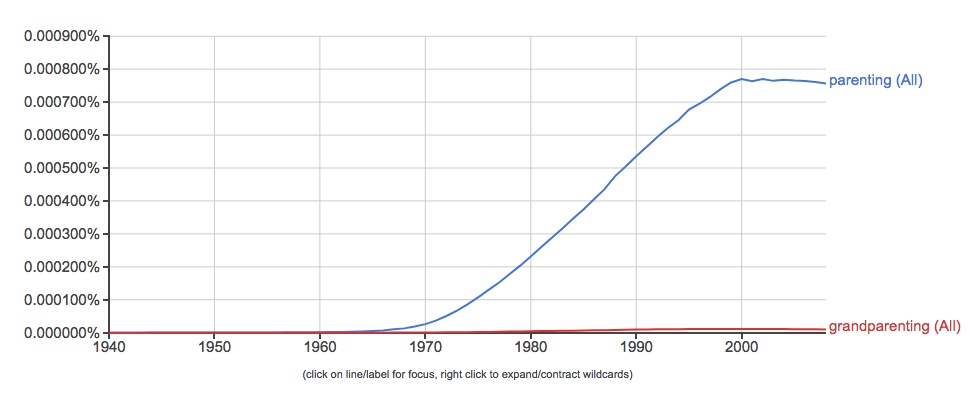
Society, families and individuals struggled with what type of care would be best for the their children. Concepts of the ideal family, gender and gender roles became more plastic. I think the increased use of the verb to parent acknowledges the unpaid work that is required to raise children.
Women in the late ’60s and
There was also reverse criticism by working parents of the stay-at-home parent.
Our post-war parents were disdainful of our child-rearing angst regardless of what choice was made.
“She’s killing herself. Why doesn’t she just stay home. They’ve got the money.”
“After all that training and now she is just staying at home with the kids.”
“How does he do it? Staying at home with the kids now. He was a computer programmer you know.”
“I don’t know why they had kids. They just park them at the daycare all the time.”
“That nanny they have holed up in the basement can barely speak English. How are those kids going to turn out.”
“How does she think she is ever going to keep her skills up if she takes all that time off with her baby?”
Most shamefully, often women professionals, doctors and lawyers and so on, were the greatest critics of our co-workers. The punishing intolerant system that we were somehow surviving by doing it all seemed to make it too hard to be compassionate. The combination of committed professionalism and competent parenting had not been engineered into the system. If a colleague was absent or couldn’t do the work competently due to a family emergency, the rest of us, often resentfully, had to pick up all the pieces. There were no redundancies.
Looking back at my struggle to do it all – and I truly believed it was
None of us confessed to each other how crazy it was or how tired we were. I lived under a cloud of guilt about inadequacy at both work and at home. I joined in the cruel criticism of those who weren’t doing it all. I had no self-compassion so how could I be compassionate to struggling colleagues.
Thankfully, this societal position has evolved somewhat and for the most part, the kids have turned out just fine. These kids are now young adults, millennials who are insisting that the culture change. Did they benefit from dual working parents and outsourced childcare? Are they more self-sufficient or more likely to pursue careers outside the home? Is parenting being shared more equally? Will they use a sequential model with a stay-at-home phase for each parent? Will they be less effective parenting due to the pervasive distractions of technology?
The physiological obligations of parenting such as pregnancy, labour, delivery and breastfeeding (excluding medical miracles) remain nearly exclusively female work. We can choose to support, supplement, attenuate and remunerate this burden at both societal and legislative levels.
We may be approaching the feminist value of choice for all – to be able to participate in a society that respects each individual’s right to parent in a way that suits their children and their family structure. For most family units, these choices are significantly
I think that the hardest part of the job of parenting is unpredictability. An effective employer or organization is one that allows enough flexibility for all its employees to parent well. As a society, we need to address systemic issues such as access to childcare, job security and parental leave to allow parenting in all family structures to come first.
Meanwhile, I’m grateful to have survived it all.
I refer
“I do think women can have it all, but not all at the same time. Our life comes in segments, and we have to understand that we can have it all if we’re not trying to do it all at once.”
I’ll be talking about the verb adulting next month or maybe not.