• Skip to main content
  • Skip to primary sidebar
  • Skip to footer

Carolyne J Montgomery - Reader & Writer

Carolyne Reads and Writes

  • Home
  • About
    • Socials
      • Facebook
      • Instagram
  • Watermarked Series
  • Publications & More
    • Indie Bookstores

Archives for March 2019

Adulting

March 31, 2019 by Carolyne Montgomery

After last month’s reflections on Parenting, I have been thinking about Adulting. The OED definition of adulting is the practice of behaving in a way characteristic of a responsible adult, especially the accomplishment of mundane but necessary tasks. The American Dialect Society cites a tweet from 2008 as the first documented use.  Twitter is now a recognized source for first-usage citations of neologisms.

 I searched #adulting on Twitter and scanned the topics that surfaced. They clustered around finances (not enough money), fatigue (not enough time), eating habits (wanting to do better) and celebrating the completion of or the challenges associated with various domestic tasks. These included items such as meal preparation, paying taxes, cleaning and organizing domestic items.

I tried to find a Google source that provides a definition of an adult beyond the chronological milestones (eighteen or twenty-one years old) or the ability to complete mundane or necessary tasks. Was there a measuring device such as an Adultometer or list of competencies that could be tested? 

San Gorgonio Mountain and Desert Lupins
Desert Verbena

Meanwhile, I was in Palm Springs enjoying the fresh lemons from my neighbour’s tree and the superbloom of desert flowers after the wet and cool spring.  I was also watching the invasion of three teenage Canadian tennis players into the Indian Wells Tennis tournament – Andreescu, Auger-Alliasime and Shapovalov. After the eighteen-year-old Felix Auger-Alliasime narrowly lost his match in the third game tie-breaker, he posted the following tweet.

If you can meet Triumph and Defeat and treat those two imposters just the same 

Most of you will recognize this as a quotation from Rudyard Kipling’s poem If, published in 1910. ( link to the poem is below) Rudyard Kipling was a man of his time – an era of imperialism, colonialism and white male supremacy. This poem was inspired after a bungling of leadership in the Boer war and written as advice to his son. I parsed it for the recommended adult attributes and found this list:

Calm, Confident, Cooperative, Patient, Honest, Accommodating, Understanding, Humble, Optimistic yet Realistic, Creative, Resilient (Stoic), Practical, Decisive, and Compassionate. 

You might be able to find others? I would add that self-compassion, accurate self-appraisal, tolerance of ambiguity and understanding the necessity of forgiveness are also crucial to adulting.

We used to have a cartoon on the fridge when my kids were teenagers that went something like this.

“Why does my Mum always know how to push-my-buttons.”

“She installed them.”

Maybe the journey from child to adult requires the uninstalling of all the bad buttons from childhood that interfere with self-regulation?

A successful adult knows their strengths and weaknesses . They can identify, differentiate and manage the most primal feelings such as fear, sadness and anger. They have developed a repertoire of appropriate positive behaviours that can be draw upon to manage these strong negative emotions in themselves and others.

There is more and more evidence that contented successful mature adults have developed skills that allow them to self-regulate their emotions in most contexts. They are better at self-advocacy and the optimization of their personal potential. Educators are examining methods to teach emotional literacy – the ability to understand yourself, read others and choose the behaviours that will improve social interactions.

Felix Auger-Alliasime at age eighteen in his first major tennis tournament had the wisdom to accept and learn from his defeat. He then went on to become the youngest male player to reach the semi-finals of the next major tournament in Miami. He is mature beyond his years in triumph or defeat.

Being an adult is not a chronological state and adulting is not only completing tasks such as managing your finances, getting to work on time or eating well.   Adulting is the continuous evolution of desirable characteristics and emotional skills that allow individuals to reach their personal potential. 

If  Rudyard Kipling

If you can dream—and not make dreams your master;
If you can think—and not make thoughts your aim;
If you can meet with Triumph and Disaster
And treat those two impostors just the same;

If you can bear to hear the truth you’ve spoken
Twisted by knaves to make a trap for fools,
Or watch the things you gave your life to, broken,
And stoop and build ’em up with worn-out tools:
Filed Under: Uncategorized

Parenting and Adulting

March 10, 2019 by Carolyne Montgomery

This piece started out as a meditation the verbs, parenting and adulting, both examples of when a word that is historically used as a noun (eg: parent or adult) is transformed into a working word, a doing word, a verb, to parent – the activity of bringing up a child as a parent.

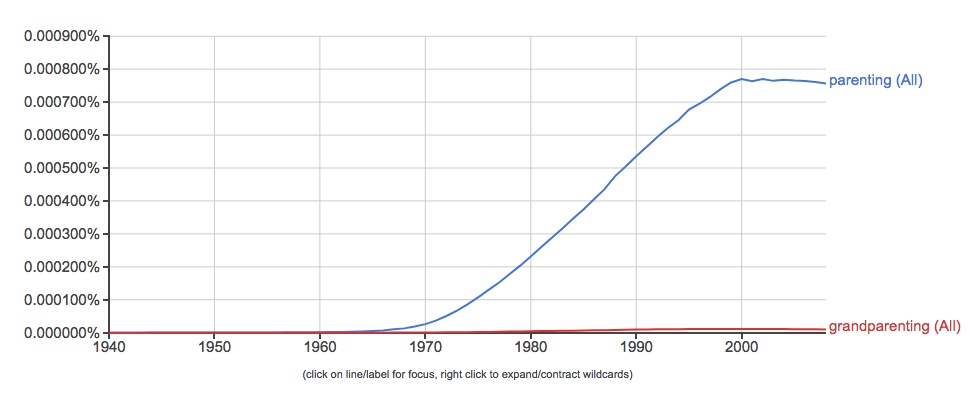
For the babyboomers, the parenting expectations and opportunities were different from their parents’ generation. With the advent effective birth control for women in the 60’s, motherhood could be postponed to allow for career development. Both parents could have careers and third-party childcare became the norm.  (Extended childcare with family and friends was routine in families of lower economic circumstances where both parents had to work.)   Although the word parenting was first coined in 1930, its usage took off in 1959.

PARENTING Google Ngram

Society, families and individuals struggled with what type of care would be best for the their children. Concepts of the ideal family, gender and gender roles became more plastic. I think the increased use of the verb to parent acknowledges the unpaid work that is required to raise children.

Women in the late ’60s and ’70s, were encouraged to pursue careers outside the home by the second-wave feminists such as Germain Greer and Betty Friedan, neither of whom had children.  Meanwhile, new feminist mothers were challenged and criticized by everybody else including their spouses and stay-at-home mothers for being negligent by outsourcing the parenting responsibilities.

There was also reverse criticism by working parents of the stay-at-home parent. The  stay-at-home was often seen as inferior, subservient, underdeveloped or unsuccessful to those who had fought for professional recognition outside the home. This disrespect was even more dire for male partners who stayed at home, where they were untrusted by both working and stay-at-home mothers.

Our post-war parents were disdainful of our child-rearing angst regardless of what choice was made.

“She’s killing herself. Why doesn’t she just stay home. They’ve got the money.”

“After all that training and now she is just staying at home with the kids.”

“How does he do it? Staying at home with the kids now. He was a computer programmer you know.”

“I don’t know why they had kids. They just park them at the daycare all the time.”

“That nanny they have holed up in the basement can barely speak English. How are those kids going to turn out.”

“How does she think she is ever going to keep her skills up if she takes all that time off with her baby?”

Most shamefully, often women professionals, doctors and lawyers and so on, were the greatest critics of our co-workers. The punishing intolerant system that we were somehow surviving by doing it all seemed to make it too hard to be compassionate. The combination of committed professionalism and competent parenting had not been engineered into the system. If a colleague was absent or couldn’t do the work competently due to a family emergency, the rest of us, often resentfully, had to pick up all the pieces. There were no redundancies.

Looking back at my struggle to do it all – and I truly believed it was doable, if only I was organized enough and worked hard enough – I could have it all – family, work-life balance, career, friends, hobbies and a healthy partnership. If I wasn’t successful then it meant I was insufficient, simply not good enough.  My success in the work place was predicated on a gender performance that was modeled on existing masculine ideals. This was decades before Sheryl Sandberg wrote Lean In.

None of us confessed to each other how crazy it was or how tired we were.  I lived under a cloud of guilt about inadequacy at both work and at home. I joined in the cruel criticism of those who weren’t doing it all. I had no self-compassion so how could I be compassionate to struggling colleagues.

Thankfully, this societal position has evolved somewhat and for the most part, the kids have turned out just fine. These kids are now young adults, millennials who are insisting that the culture change. Did they benefit from dual working parents and outsourced childcare? Are they more self-sufficient or more likely to pursue careers outside the home? Is parenting being shared more equally? Will they use a sequential model with a stay-at-home phase for each parent? Will they be less effective parenting due to the pervasive distractions of technology?

The physiological obligations of parenting such as pregnancy, labour, delivery and breastfeeding (excluding medical miracles) remain nearly exclusively female work.  We can choose to support, supplement, attenuate and remunerate this burden at both societal and legislative levels.

We may be approaching the feminist value of choice for all – to be able to participate in a society that respects each individual’s right to parent in a way that suits their children and their family structure. For most family units, these choices are significantly influenced economic considerations. They should not be limited by societal expectations. 

I think that the hardest part of the job of parenting is unpredictability. An effective employer or organization is one that allows enough flexibility for all its employees to parent well.  As a society, we need to address systemic issues such as access to childcare, job security and parental leave to allow parenting in all family structures to come first.

Meanwhile, I’m grateful to have survived it all.

I refer you to Anne Marie Slaughter from 2012 talking about why women still can’t have it all and a quote from Madeleine Albright in conversation with Anne Marie Slaughter in 2013.

 “I do think women can have it all, but not all at the same time. Our life comes in segments, and we have to understand that we can have it all if we’re not trying to do it all at once.”

I’ll be talking about the verb adulting next month or maybe not.

Filed Under: Uncategorized

Primary Sidebar

Recent Posts

  • Watermarked Series
  • January in Comox
  • A Swimming Adventure in Barbados
  • How I spent my summer vacation
  • Finding Your Soul Speed: The Power of Poetry Memorization

Archives

  • January 2026
  • November 2025
  • September 2025
  • May 2025
  • December 2024
  • October 2024
  • July 2024
  • June 2024
  • May 2024
  • November 2023
  • October 2023
  • August 2023
  • November 2022
  • May 2022
  • March 2022
  • December 2021
  • October 2021
  • June 2021
  • April 2021
  • February 2021
  • December 2020
  • October 2020
  • July 2020
  • May 2020
  • March 2020
  • February 2020
  • January 2020
  • November 2019
  • October 2019
  • September 2019
  • July 2019
  • June 2019
  • May 2019
  • March 2019
  • January 2019
  • December 2018
  • October 2018
  • August 2018

Pages

  • A Swim in a Pond in the Rain – A Commentary
  • About Carolyne Jane Montgomery
  • Contact
  • Home
  • Independent Bookstores
  • Privacy Policy
  • Publications, Readings and Other Stuff
    • The Solstice Party
  • Signup

Copyright © 2026 · Carolyne Montgomery · All Rights Reserved | Support by Mastermynde